


San Diego has seen what a powerful El Niño can do.
Now, as another unusually strong El Niño develops in the tropical Pacific, the winter of 1997-98 offers a striking reminder of how dramatically the region can change when heavy rain, swollen rivers, saturated hillsides and powerful surf arrive together.
A Sept. 10 outlook published by the National Oceanic and Atmospheric Administration (NOAA) gives El Niño a greater than 90% chance of reaching very strong strength during the Northern Hemisphere fall and winter of 2026-27. NOAA also puts the chance at 75% that the October-through-December period will qualify as a historic-strength event, exceeding the strength of previous El Niño events in the modern record dating to 1950.
That does not mean San Diego is guaranteed another season like 1997-98. NOAA cautions that even a very strong El Niño does not automatically produce the same local weather impacts.
But the winter of 1997-98 provides a memorable example of what can happen when a powerful El Niño combines with Southern California’s weather patterns and exposed coastline.
The winter San Diego remembers
The 1997-98 El Niño was one of the strongest events in the modern record.
At Lindbergh Field, the 1997-98 rainfall season produced 17.78 inches of precipitation — roughly 180% of normal.
The San Diego River responded dramatically.
During the Feb. 7-8 1998 storm, the river reached 12.5 feet at Fashion Valley, about 1.2 feet above flood stage.
Then came another major storm later that month.
On Feb. 24, the San Diego River reached 15.1 feet at Fashion Valley at about 4 a.m., approximately 3.8 feet above flood stage. Low-lying roads, golf courses and parking facilities were inundated for the third time that month.
Elsewhere in the county, about 200 people were evacuated from three mobile-home parks in Oceanside. Portions of Camp Pendleton flooded because of Loma Alta Creek.
The wet conditions also contributed to sinkholes, including one near Interstate 15 and Balboa Avenue that was reported at approximately 550 feet long, 35 feet wide,e and 65 feet deep.
The agricultural industry also took a hit, with wet weather damaging strawberries, winter vegetables, citrus and avocado groves and hurting the region’s flower industry.

The coast took its own beating
The California Coastal Commission (CCC) documented extensive damage along the San Diego County coast during the 1997-98 El Niño.
By Aug. 14, 1998, the commission had granted 23 El Niño-related emergency permits along the San Diego coast.
Oceanside Harbor was closed twice because of high surf, with approximately $700,000 in storm damage reported.
At Cardiff State Beach, the North lot was damaged, while the South Cardiff lot, walkways, railings, landscaping, and restrooms were destroyed or significantly damaged. Highway 101 was repeatedly closed because of wave run-up and flying cobbles.
In Solana Beach, temporary riprap was installed along 15 properties, while emergency permits addressed erosion and sea caves.
Del Mar reported approximately $1.6 million in damage, with three homes damaged beyond repair and emergency permits issued for protective rock.
Pacific Beach and Mission Beach also experienced damage to their boardwalks.
The CCC noted that the 1997-98 event was among the most damaging and well-documented El Niños in California’s modern record. It also noted that the hazards associated with extreme El Niño events can include high waves, flooding, erosion, landslides, debris flows, road closures, and structural damage.
The effects were not limited to the coastline. Saturated ground, swollen waterways, and repeated storms affected communities throughout the region.
What exactly is El Niño?
El Niño is part of the El Niño-Southern Oscillation, or ENSO, a recurring climate pattern involving changes in ocean temperatures and atmospheric circulation across the tropical Pacific.
During El Niño, unusually warm surface water develops across the central and eastern tropical Pacific. That warming can alter atmospheric circulation, the jet stream, ream and the tracks followed by winter storms.
Strong El Niño events are often associated with wetter conditions in Southern California and larger waves along the coast. But an El Niño does not guarantee a particular amount of rain or a particular number of storms.
As the commission points out, the impacts depend on the interaction of waves, winds, tides, precipitation, and other factors — and each El Niño is different.
That distinction matters when comparing 2026-27 with 1997-98.
Why does the modern record begin in 1950?
The year 1950 does not mark the discovery of El Niño.
Scientists had been studying the atmospheric and oceanic patterns involved in ENSO for decades. What changed over time was the availability of consistent observations and a systematic way to compare events.
NOAA’s historical ENSO measurements use 1950 as the beginning of the modern record used for comparison. That gives scientists a consistent baseline for examining the strength of individual events.
The record includes several major El Niños, including those of 1957-58, 1965-66, 1972-73, 1982-83, 1991-92, 1997-98, and 2015-16.
The 1982-83 and 1997-98 events are particularly important because both produced extensive and well-documented impacts in California. The CCC classifies both as extreme events in the modern record.
1997-98 wasn’t the only big one
San Diego’s history shows why it is important not to treat every major flood as an El Niño event.
The region has experienced serious flooding during many different weather patterns and in many different years.
That includes the catastrophic flood of 1916, major floods in 1927 and 1937, significant flooding in 1978 and 1980, and additional major floods in later decades.
The historical record reminds us that El Niño can increase the likelihood of certain kinds of winter weather, but flooding in San Diego has never depended on El Niño alone.
San Diego’s floods: A history of high water
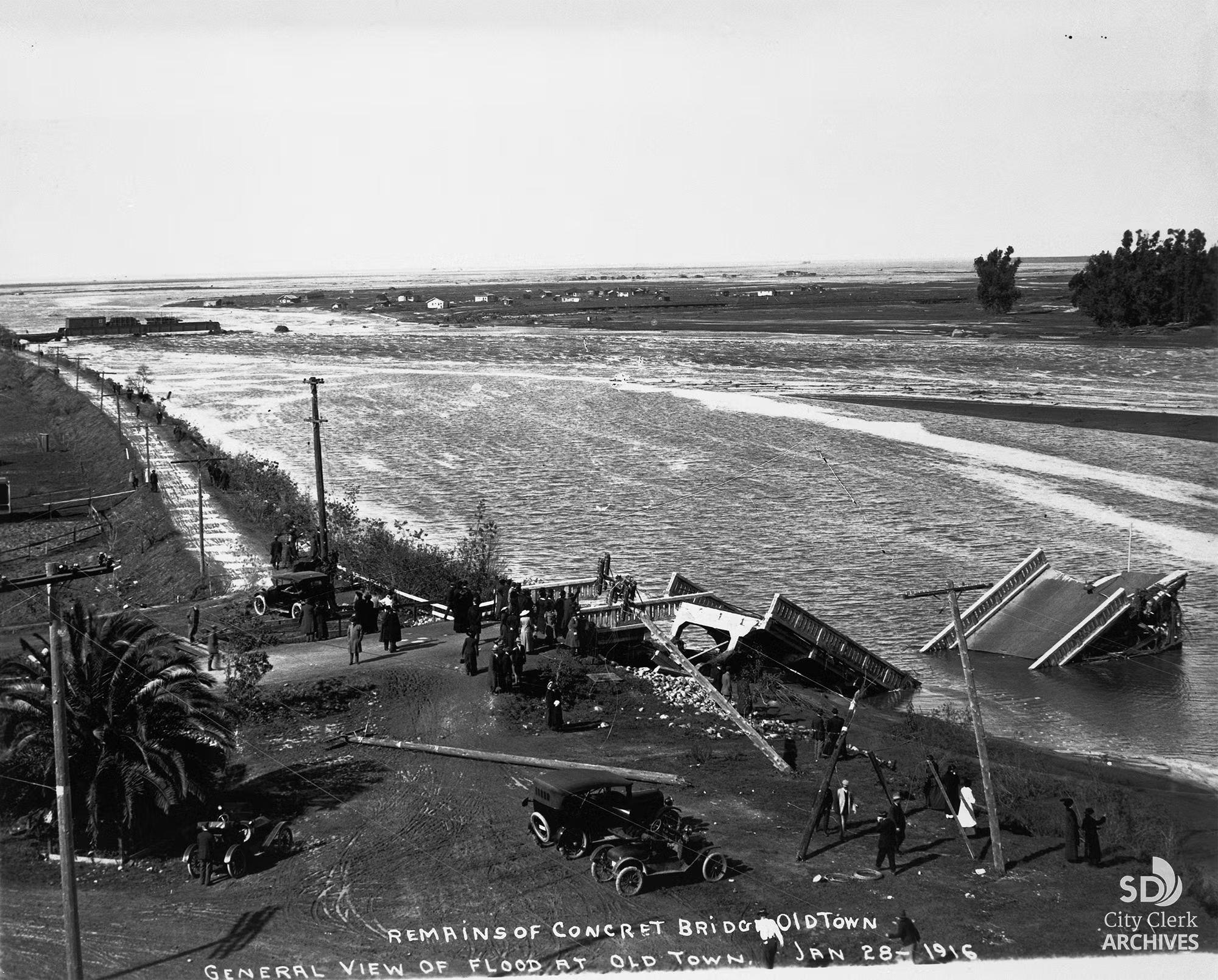
The January 1916 flood remains one of San Diego’s most destructive weather disasters.
According to the city of San Diego, 22 people died. Bridges, roads, and railroad lines were washed out, dams collapsed, houses were swept away, and downtown San Diego was inundated with water reaching as much as five feet deep.

The photographs above show the San Diego River at Old Town during that flood.
The 1980 floods provide another example.

Prolonged heavy rain produced major flooding in Mission Valley, including the area around Fashion Valley Road shown in the photograph above.
Historian Philip R. Pryde’s research on the San Diego River and Mission Valley places the 1980 flooding within a much longer history of efforts to understand and control the river and its floodplain.
San Diego has therefore experienced serious flooding during many different kinds of weather patterns — not only during El Niño years.
That history is important context as the current El Niño strengthens.

The question is not whether San Diego will experience an exact repeat of 1997-98. Weather patterns vary from year to year.
But the old photographs tell a consistent story: powerful storms can overwhelm rivers, saturate hillsides, damage roads and buildings, and batter San Diego’s exposed coastline.
And if this winter’s El Niño becomes as strong as current forecasts suggest, the lessons of those earlier storms could become relevant again.
Read more history stories here. Do you have a story to tell? Send an email to DebbieSklar@cox.net
Sources:
- NOAA Climate Prediction Center, ENSO Diagnostic Discussion, Sept. 10, 2026.
- NOAA Climate Prediction Center, Official ENSO Strength Probabilities, September 2026.
- NOAA Climate Prediction Center, Official NOAA Relative Oceanic Niño Index (RONI) Outlook.
- California Coastal Commission, “Extreme Weather: El Niño.”
- California Coastal Commission, “Questions and Answers on El Niño.”
- California Coastal Commission, “1997-98 El Niño: A Brief Biography.”
- California Coastal Commission, “El Niño for 2026-2027 Winter Season”/”2026-27 El Niño Informational Memo.”
- City of San Diego Digital Archives, “San Diego River at Old Town, 1916 Flood.”
- City of San Diego Digital Archives, “January 28, 1916 — Flood in San Diego.”
- San Diego History Center, “The Day the San Diego River Was Saved: The History of Floods and Floodplain Planning in Mission Valley,” by Phillip R. Pryde.


