

Pacific Beach is now lined with restaurants, apartments, shops and busy streets. But in the late 1880s, when the community was still being promoted as a new seaside resort, one of its more unusual businesses was an asbestos factory.
The plant was established in 1888 near the Pacific Beach driving park, the horse-racing track that stood north of Mission Bay and east of Rose Creek.
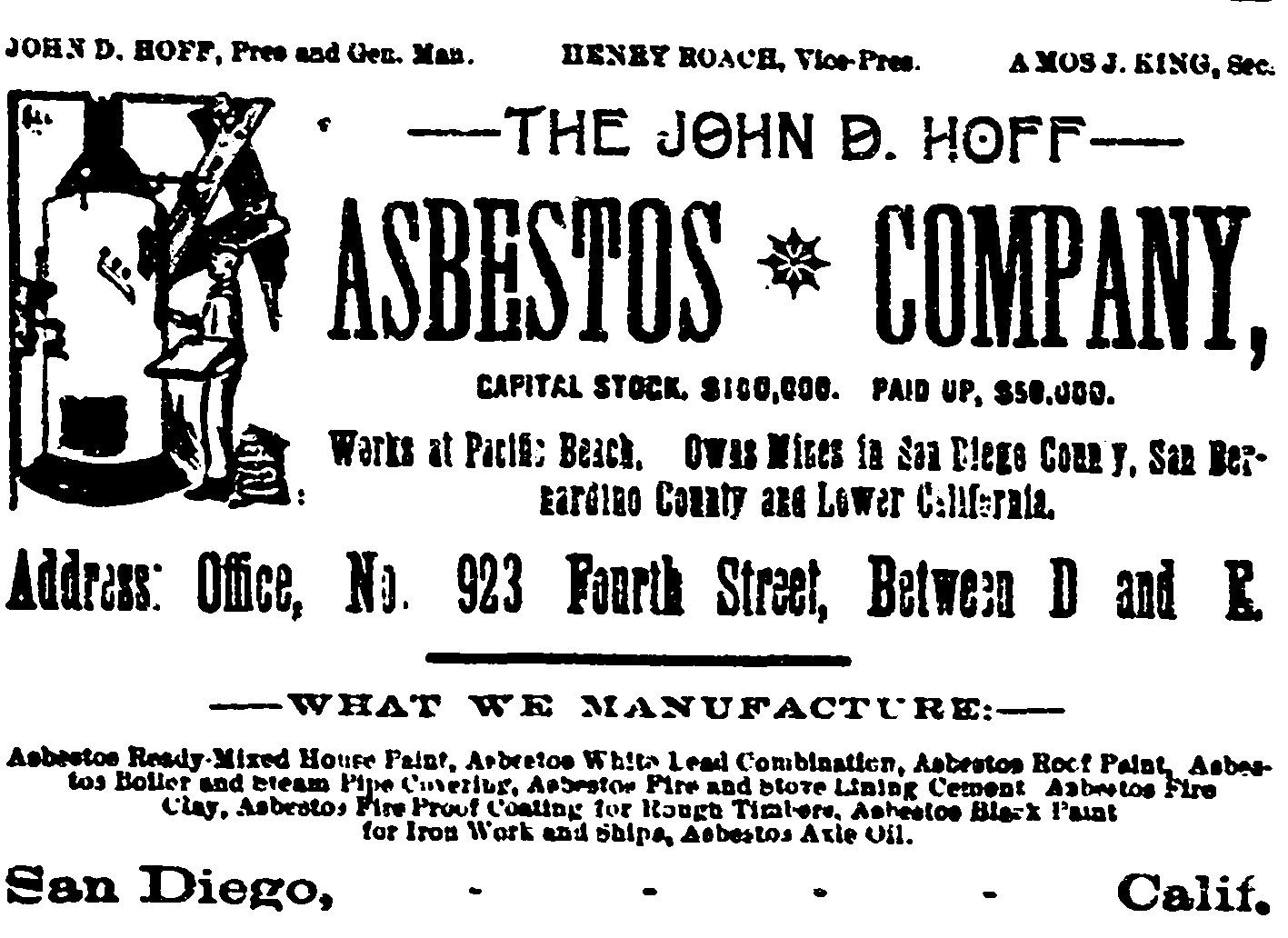
The San Diego Asbestos Mining and Manufacturing Co. planned a factory capable of processing as much as 8,000 pounds of asbestos a day. The raw material came from mines near Elsinore and was used to manufacture products including boiler coverings, fireproof cement and roof paint.
George W. Hazzard, a prominent San Diego businessman, was one of the project’s principal promoters. John D. Hoff, who had developed asbestos mining interests near Elsinore, became manager.
The factory was designed to take advantage of the railroad.
A spur from the Pacific Beach railway served the works, allowing raw material to be brought in and finished products shipped out. Railroad timetables listed an actual stop called Asbestos Works.
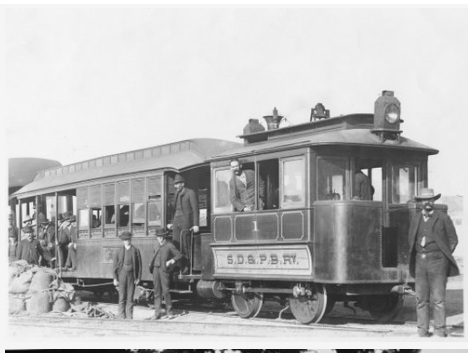
The factory quickly became a working industrial operation.
By 1889, advertisements were promoting its asbestos products, including fireproof roof paint, boiler covering, and fireproof cement. The company also advertised testimonials from local customers using its products.
Production expanded the following year. A large paint machine arrived in 1890, and the company replaced its original engine with additional equipment to power crushers and grinders used to process asbestos for paint.
The business also shipped its products beyond San Diego. A May 1890 report in the San Diego Union described a large shipment of asbestos goods being sent from Pacific Beach to San Francisco. The company also received an order from Denver for two tons of asbestos roofing and paint.
For a few years, the factory represented the kind of industrial growth that Pacific Beach promoters hoped would accompany the community’s development.
But the boom did not last.
San Diego’s great real-estate boom of the late 1880s had collapsed, and the city’s population and economy weakened. The asbestos operation also faced problems getting raw material from its mines after the railroad between San Diego and the Elsinore area washed out in 1891 and was never rebuilt.
The company changed names as its fortunes declined. In December 1891, the Pacific Asbestos Co. was incorporated as the successor to the John D. Hoff Asbestos Co. The works remained in Pacific Beach, while the new company’s main office was established in Los Angeles and a branch office in San Diego.

By July 1892, the railroad timetable still listed Asbestos Works as a stop. By July 24, the stop had disappeared from the timetable.
The factory itself soon disappeared.
Historical property records indicate that the asbestos works had been shut down and dismantled by the end of 1893. By then, the once-promising industrial operation had become another vanished piece of Pacific Beach’s early development.
The works were generally located in the vicinity of present-day Soledad Mountain Road and Garnet Avenue, although the exact location of the factory within the larger property has not been definitively established.
Today, no trace of the factory remains.
For a few years, however, Pacific Beach was home to a business that produced asbestos-based paints, boiler coverings and other fireproofing products — and had its own railroad stop to move them.
Read more history stories here. Do you have a story to tell? Send an email to DebbieSklar@cox.net.
Sources:
- San Diego History Center, “Mercantile to MacDonald’s.”
- San Diego City Directory, 1892–93, listing for “John D. Hoff, Asbestos Co.”
- San Diego City Directory, 1893–94, listing for “Hoff John D., Asbestos Co factory, Pacific Beach.”
- San Diego Public Library, California Collection and San Diego Union collection.
- The Websters, “PB Asbestos Works.”
- Stephen R. Van Wormer, “Alfred H. Isham: A Gilded Age Entrepreneur in San Diego County,” Southern California Quarterly, Vol. 66, No. 4 (Winter 1984).


