

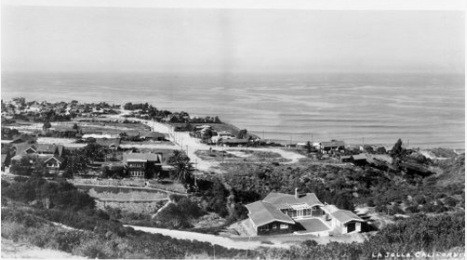
What would convince you to buy a home on a steep, largely undeveloped La Jolla hillside in the 1920s?
For the developers of Ludington Heights, the answer was simple: the view.
In a 1928 newspaper advertisement, the new Mount Soledad subdivision was promoted as “Jewel City” and “The Gem Supreme,” promising buyers spectacular marine and mountain views and calling the area one of the most beautiful parts of La Jolla. The advertisement also touted its proximity to the Country Club and golf course.
Ludington Heights took shape during the major building boom that transformed La Jolla in the 1920s. The city of San Diego’s historical research identifies Ludington Heights among the subdivisions developed during that period, as residential construction spread onto the slopes of Mount Soledad and beyond the older village center.
The subdivision’s official map, Map No. 2023, was recorded in 1927. City records identify the subdivision as Ludington Heights and document W.F. Ludington’s involvement with property there.
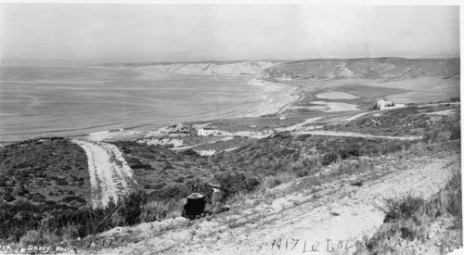
Ludington wasn’t simply selling parcels of land. He was selling a lifestyle — and the views were the centerpiece.
The 1928 advertisement described the marine and mountain views as “superb” and “unobstructable,” while promising prospective buyers a highly improved residential community. The language reflected the aggressive promotional style used by La Jolla developers during the real estate boom of the era.
There was, however, one practical problem: Mount Soledad is steep. Very steep.
The neighborhood’s streets and roads had to accommodate the hillside terrain rather than follow the kind of straightforward grid found in flatter parts of San Diego. One of the most distinctive reminders of that challenge is the small arched bridge on Al Bahr Drive.
Built in the late 1920s, the bridge closely resembles Balboa Park’s Cabrillo Bridge. Historical accounts have linked the smaller bridge to William French Ludington, who was involved with the Panama-California Exposition and its development. The resemblance to Cabrillo Bridge has also been described as intentional.
Ludington Heights also retained a tiny piece of land for public use.
A 0.08-acre parcel at Crespo and Al Bahr Drive was included in the original 1927 subdivision dedication. The property was changed to open space in 1978 and is identified by the City of San Diego as Ludington Heights Open Space Park No. 1.

The neighborhood’s name may not be as familiar today as La Jolla Shores, Bird Rock or the Village, but Ludington Heights helps tell the story of how La Jolla expanded during the 1920s.
Developers were taking land that presented difficult terrain and marketing it as desirable residential property. Their sales pitch emphasized scenery, location and the promise of a distinctive community on the slopes of Mount Soledad.
Nearly a century later, the view remains the neighborhood’s greatest selling point.
The 1928 advertisement called Ludington Heights “The Gem Supreme.” And the views that helped sell those lots nearly a century ago are still there.
Read more history stories here. Do you have a story to tell? Send an email to DebbieSklar@cox.net
Sources:
City of San Diego, La Jolla Historical Reconnaissance Survey — Cultural Landscape.
City of San Diego, Historical Resource Technical Report.
La Jolla Journal, July 12, 1928.
City of San Diego Digital Archives, Ludington Heights records .
San Diego History Center historical resources on La Jolla and William French Ludington.


