In his teens, Jim Trotter was a three-sport athlete.
He was a center fielder in baseball, a long and triple jumper in track and a four-year football player at Lincoln High School in Stockton.
The former San Diego Union-Tribune sports writer shined brightest on the prep gridiron, however.
“Serving as Lincoln’s top receiving threat is senior split end Jim Trotter (5-11, 175),” said a season preview in the Turlock Daily Journal.
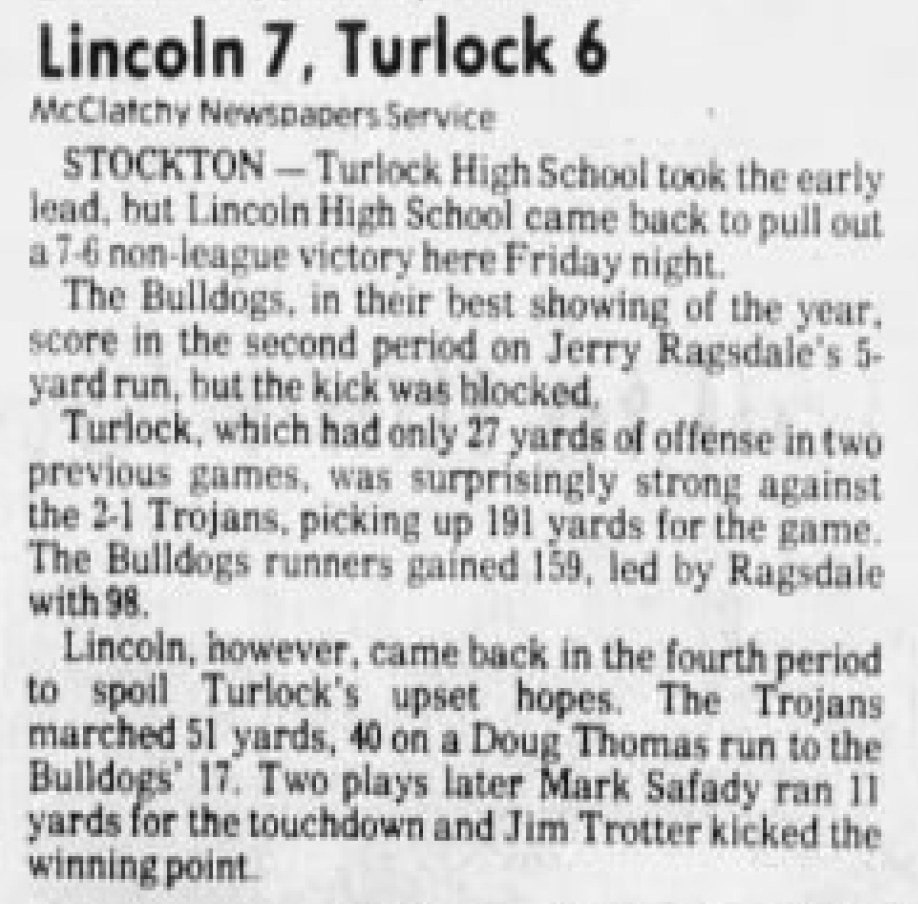
The Modesto Bee noted how Trotter, a kicker for the Trojans his junior year, scored the winning point in a 7-6 victory over Turlock in September 1979. A year later, said another story, he caught a 38-yard pass from QB Tim Sharrock during a scoring drive against Oakdale.
And in December 1980, the Bee named Trotter a second-team defensive back in the San Joaquin Athletic Association, now part of a CIF section.
But at Lincoln, Trotter aspired to be a sports reporter. So how’d he do at his school’s newspaper?
He didn’t.
“Obviously, I couldn’t participate [on the campus paper] because of the conflict of interest,” he told Times of San Diego. “So it wasn’t until I got to college that I could sort of dive into it.”
Firing Sparks Lawsuit
Decades later, that same sense of ethics and professionalism led him to grill NFL Commissioner Roger Goodell — his ultimate boss — at two Super Bowl press conferences.
He bit the hand that fed him, and paid a price.
By highlighting the absence of fellow Blacks in NFL Media management and the copy desk, Trotter wrote his own obituary after five award-winning years with the NFL’s broadcast arm and newsroom.
He was fired, he said in a September 2023 lawsuit, as retaliation for his tough questioning. The NFL failed to get the case dismissed.
But last month, he settled with the New York-based league, disclosing little about the deal except NFL funds would go to a foundation to help future journalists attending HBCUs — historically black colleges and universities.
Trotter attended one himself — transferring to Howard University in Washington, D.C., after two years at Cal State Hayward (now CSU East Bay).
James J. Trotter III rose to sports editor of Howard’s student weekly, The Hilltop. But even then his high standards led to his downfall.
Grievances at The Hilltop
He spoke truth to power — The Hilltop’s editor in chief — and was sacked.
Trotter, 61, told me he was among a group of staffers upset over an editorial cartoon that wasn’t allowed to be published.
“We felt we should run it and so we protested against it, and I ended up getting fired,” he said in a recent phone interview from his home in Chula Vista.
In The Hilltop’s telling, though, 14 staff members (with Trotter one of their leaders) lost their jobs after staging a “walkout” and demanding that Carol Winn, the paper’s top student editor, be ousted for incompetence that included losing reporters’ copy and the paper losing money.
A three-page list of staff grievances in October 1985 had only one demand: Winn’s resignation.
But the faculty board in charge of The Hilltop backed Winn. She kept her job at the oldest black student newspaper in America (founded in 1924).
Among many other things, Trotter in 1985 recounted an “emotional blow-up” between the editor and her editorial-page chief.
“During the argument, Trotter claims that Winn was heard to say ‘all editorials need not apply to Black people,'” the paper said.
Last week, Trotter was asked to reflect on The Hilltop firing. He replied: “No regrets. No hard feelings.”
In 1986, Trotter earned a degree in broadcast journalism. A fellow Howard grad that year was a sorority girl named Kamala Harris.

Harris was a political science and economics major, though, and Trotter says he never “crossed paths” with her. (But they shared family circumstances — both being raised by single mothers, although Trotter’s mom eventually remarried.)
“I was so focused on trying to prepare myself for a career that I wasn’t one of those guys who was attending [Howard] parties or going out and about,” he said. “I was truly trying to prepare myself,” which included working in the sports information office.
Trotter wasn’t as ambitious as the future California attorney general, senator and vice president — born in Oakland across the bay from Trotter, who emerged at San Francisco General Hospital.
‘Had Things to Learn’
He had a choice of jobs after Howard — a full-time prep sports position with the 50,000-circulation Muskegon Chronicle in western Michigan or a paid six-month internship with the prestigious Cleveland Plain Dealer that could lead to a full-time gig.
(He pivoted from broadcasting to print journalism before his senior year, however, saying: “I wanted to be judged on my work and not how I looked or how I sounded. … I felt that I would be judged more fairly.”)
Trotter chose Michigan, feeling he wasn’t ready for the bigs.
“I knew I still had things to learn,” he said. “And it was the best decision I could have made.”

He was introduced to readers in July 1986.
Trotter spent 10 months at the Chronicle, musing about the change in his weather fortunes. Next came the Tacoma (Wash.) News Tribune, where for almost two years he covered many prep sports and frequently had three bylines a day. He quoted Shakespeare and San Diego’s late Jim Croce.
An editorial in the Tacoma daily cited Trotter’s work detailing a crisis — a massive turnover and shortage of public-school athletic coaches.
Trotter found his way to The San Diego Union after being recommended by a sports copy editor impressed with Trotter’s stories in papers he critiqued. The late Bob Wright, the Union sports editor, immediately hired him in 1989 to cover preps.
Not long after, he began backing up Kevin Kernan on the Chargers beat. But Kernan would leave in 1997 for a 23-year career at the New York Post, and the Union-Tribune sought a successor.
Trotter was offered the top sports writing job at the U-T.
He said no.
He was covering the NBA and didn’t want to change. Then veteran columnist Nick Canepa spoke truth to Trotter.
“Nick told me: If they’re offering it to you, [you] have to take it,” Trotter recalls. “So anyone who doesn’t like my NFL coverage, they have Nick” to blame.
Chargers linebacker Junior Seau also took Trotter under his wing, schooling him on the “culture of a locker room and the mindset of an elite athlete.”

After Seau committed suicide in 2012, Trotter at first spurned inquiries about writing a book about the Bolts great.
“But those close to him told me that if anyone was going to write his story, they believed he would’ve wanted me to write it,” Trotter told ESPN in 2015 after publication of “Junior Seau: The Life and Death of a Football Icon.”
“At that point, I decided I wanted to tell his story,” he said, taking a brief leave of absence from Sports Illustrated for the project, before moving to ESPN.
“I was clear in my own mind that it would not be a tell-all, but instead a book to explain why he was so beloved by so many people, and to explore some of the factors that might have led to his death.”
Canepa contributed a blurb: “No media member is better qualified to write this book than Trotter.”
Canepa has publicly cited racism against Trotter he observed in TSA airport lines. But Trotter won’t give other examples, saying: “Honestly, it’s not even worth getting into — it just sounds like crying or whining.”
But how does he deal with bigots or bad behavior?
“What day of the week is it?” he says before turning serious: “Hopefully [as] you get older, you get wiser.”
He admits that he used to get angry and “bark back.” Now he’s closer to tuning out racists and “not letting it affect me. … There’s no good to come of [responding with ire]. So I’ve learned to protect my energies.”
Trotter’s star, on the rise in 18 years at the U-T, ascended further after becoming, in 2007, a senior writer for Sports Illustrated. That stint lasted till March 2014. Then he spent almost four years as an NFL reporter with ESPN.
In March 2020, Trotter signed a contract with NFL Enterprises that said, in part: “You are expected to objectively report and comment on current information relative to the National Football League, its Member Clubs and its players, frequently including providing your personal opinion with regard to such matters.”
So he did.
Despite the contract’s clarity, Trotter asked NFL Media boss Mark Quenzel about covering sensitive topics.
“We will always cover the news, but we may not opine on it,” Quenzel told Trotter.
‘That Became a Problem’
Trotter said that in his “naivete,” he thought he could live with that edict “because the facts will tell the story.”
“What I didn’t realize was if we knew things that other media outlets didn’t know and it reflected poorly on the league or certain owners, then we wouldn’t report it. And so that became a problem,” Trotter said in our 50-minute chat.
Another problem for Trotter was the “both-sidesing of every issue.” Meaning, he had to have NFL input on any matter involving the league or ownership even if the story didn’t demand it.
Today Trotter says: “It’s pretty clear that we had a disagreement over what I wanted to say and what I was allowed to say at times.”
But he concedes: “Every paper and website I’ve ever worked at has had some considerations beyond my control that I couldn’t do what I wanted to do.”
In his current job as a senior opinion writer for The Athletic, owned by The New York Times, Trotter faced another conflict with corporate.


Trotter complained recently about The Athletic “watering down” his column about Nick Bosa of the San Francisco 49ers (younger brother of the Chargers’ Joey Bosa) crashing an NBC postgame interview to point at his “Make America Great Again” cap.
Nick Bosa eventually was fined $11,255 for violating NFL uniform rules — wearing a hat that contained a personal message.
Is Trotter worried he’ll be muzzled by The Athletic on future stories?
“I think there’s always a concern about that, as an opinion writer,” he told me. “It can be a delicate dance … between writer and editor or writer and, you know, organizational policies.”
He said he believed in “true transparency.”
“I try and be as honest with the reader as I can,” he said. “I try to be as authentic as I can but also have to understand that … I don’t own The New York Times. And so there are people that I answer to that have the final decision.”
He then asked: “Am I going to change who I am or how I write? No, I’m not.”
Trotter’s transparency doesn’t extend to his NFL settlement, which forbids him from sharing details — especially the amount of money coming for Trotter’s Work Plan Pray Foundation (named for a Seau saying: “Work for today, plan for tomorrow, pray for the rest”).

But as a 501(c)(3) nonprofit, the foundation may eventually reveal, via its IRS-required Form 990 filings, how much it got. Even if donor names aren’t listed.
Asked his reaction to former Obama Attorney General Loretta Lynch representing the NFL against him, Trotter laughed and said he wasn’t surprised at all.
“I’ve been covering the NFL for three decades,” he said. “So I have a pretty good understanding of how it operates. And I’m just going to leave it at that.”
Trotter said he had no idea whether his settlement might affect the so-called Rooney Rule — which requires teams to interview at least one minority candidate for head coaching and other team jobs.
But Trotter says he — among others — considers the Rooney Rule window dressing “because you can’t legislate, you know, morality. You can’t legislate for someone to understand the importance of diverse representation.”
“So it is not a secret that others who have interviewed under the rule have come out and said that it was a sham. I believe Brian Flores made that allegation in his lawsuit” after being passed over for head coaching jobs.
NFL’s ‘Filthy Wash’
Theories emerged on why the NFL settled instead of taking the case to trial before U.S. District Judge Jed S. Rakoff in New York.
U-T columnist Canepa wrote: “No chance … The League wanted a trial held in a laundromat, where all its filthy wash might be exposed.”
Trotter, married to a Cal State Hayward alumna and father of two adult daughters, told the Dan Le Batard Show that he couldn’t achieve, through the lawsuit, his goal of getting the NFL to diversify the racial makeup of management.
“When I filed the lawsuit, [my lawyers] said: ‘What do you want from this?’ And I always said, ‘I want change. I want positive change.'”
He was referring to the NFL newsroom — which had no Black managers, copy editors or even full-time news assistants.
But first he’d have to state a legal claim — that his firing was illegal retaliation.
“So I was told not just by my attorneys but others that … under the law you cannot force a corporation to hire based on race, which I understand,” he told me. “And so after that I said, ‘OK, then if we can’t make change that way, what is the best way that we can make change?’ And I felt it would be by paying it forward.”
Thus the foundation.
“From the very beginning,” he said, “I always had a component of (wanting) to create a foundation that would provide monies, scholarships, resources to aspiring journalists at historically black colleges and universities.”
So through his nonprofit, Trotter is making the case a teachable — and lucrative — moment.
He also plans to resume his once-a-semester teaching gig at San Diego State University. (His sports journalism course was paused this year amid fears he’d be called away to a New York trial.)
His foundation will depart from practice of having highly paid executive directors and board members, however. (He isn’t ready to divulge his board, though.)
“I know where their hearts are and we’re just working on it for free, you know,” he said, vowing “every dime that we raise” will go “towards these kids.”
“None of us are getting anything out of it other than satisfaction of doing a job.”
Trotter also pledges the money will have maximum impact.
He says he’s asked his board and advisers to take their time and “come up with as many ideas as we can on how we can make a true impact on these students.”
“And I’ve asked that everyone think outside the box, take nothing off the table and then let’s sit down and have a conversation about all the ideas and hopefully come up with something that’s truly impactful.”
That could include subsidizing internships at professional outlets that sometimes don’t pay — which he encountered during college.
Vision for Foundation
“If you were someone like me, who didn’t come from money and didn’t have money, you would have to turn down that internship opportunity because you couldn’t afford housing or food or those sorts of things,” he said.
(Trotter himself received an academic scholarship and says he came out of college debt free.)
He added: “We’re going to try as well look to partner with other groups who have an interest in this so that we can raise even more money and ideally my vision is that we can create an endowment that lives on well past my time on this earth and can be beneficial to these students who are coming behind us.”
When asked when he expected to retire, he replied: “Good question. I ask myself that a lot.”
He said he’s doing “reverse math” — mindful that his father passed last year at age 81.
“So if I’m to have the same life expectancy, it means that I have 20 years left and if you subtract a few years where he wasn’t in good health that maybe I have 15 years of quality life,” he said. “So you ask yourself: How do you want to spend those 15 years?”
As for Trotter: “I want to try and enjoy them. And do the things that are important to me and be around the people who are important to me.”
The foundation is one of those things.
Its first financial awards may be to students at his alma mater in 2025, with Howard possibly creating an endowment to keep the funds flowing yearly.
“I look forward to moving forward and look forward to making a difference, you know, with these young students,” he said. “And if I can do that, it will have all been worthwhile.”