


Part three of a three-part series exploring San Diego’s long-forgotten motor lodges and the roadside culture that grew around them.
A city directory can tell you where a motel stood. A postcard can show you what it looked like. A photograph can put it back on the street for a moment.
The harder question is what happened afterward.
Across San Diego County, roadside motor lodges were built around a simple idea: Travelers arrived by car, pulled into a convenient parking space and stayed close to the road.
By the 1950s and 1960s, that formula had transformed places such as Mission Valley, San Ysidro, Pacific Beach, Carlsbad and Oceanside.
But the roadside landscape did not stay frozen in place.
Some motels were demolished. Others changed names. Some properties became housing or were absorbed into new developments. A few survived in altered form.
Their endings tell another part of the story.
Rancho 101 carried a piece of a racetrack into the motel age
One of the strangest connections between San Diego’s earlier resort history and the motel era could be found in Pacific Beach.
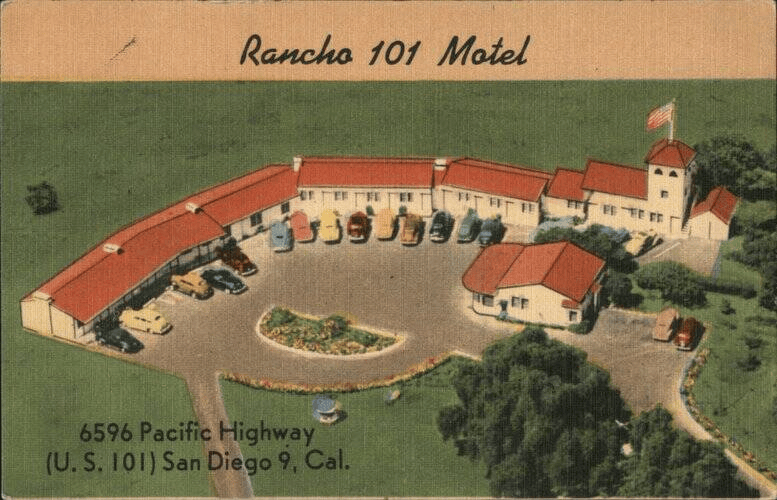
Rancho 101 Motel, Pacific Beach, built on the former Pacific Beach Driving Park site. The 1947 motel incorporated the old racetrack judges’ stand. (Photo/postcard courtesy of CardCow.)
The property at 4570 East Mission Bay Drive had once been the site of the Pacific Beach Driving Park, a horse-racing track established in 1888.
A portion of the old track’s three-story judges’ stand survived into the automobile era. In 1947, the judges’ stand was incorporated into the Rancho 101 Motel, creating an unusual link between an 1880s racetrack and the postwar roadside lodging boom.
The Pacific Beach Community Plan notes that the former driving-park site later became occupied by a series of automobile dealerships beginning in the mid-1960s.
The motel landscape therefore represented only one chapter in a property that had already served several very different eras of transportation and recreation.
Mission Valley became a motel landscape of its own
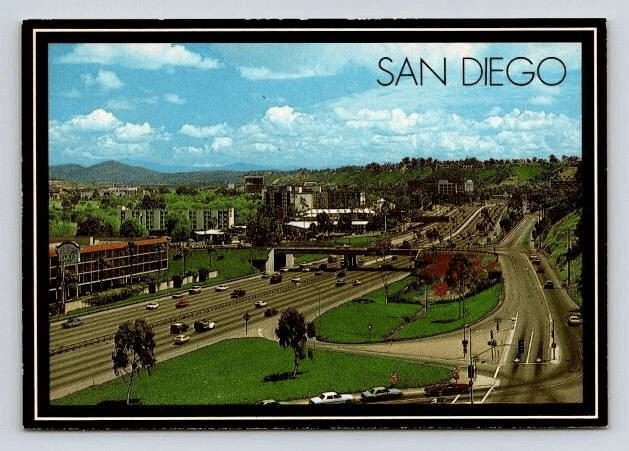
Mission Valley was one of the places where the postwar motel boom became particularly visible.
The development of Hotel Circle was spearheaded by developer Charles H. Brown, who saw the valley’s highway connections as an opportunity to attract travelers and business away from downtown.
The City of San Diego’s Mission Valley Historic Context Statement describes a deliberate effort to create low-density, garden-style hotels and motels along the highway. The buildings were generally one or two stories, with rooms arranged around landscaped areas and parking located nearby so guests could reach their rooms directly from their cars.
The concept was perfectly suited to the automobile age.
Among the early properties was the Mission Valley Lodge at 875 Hotel Circle South, designed by architect Richard George Wheeler and built in 1959. It has since been demolished.
But the Mission Valley story is much larger than a single motel.
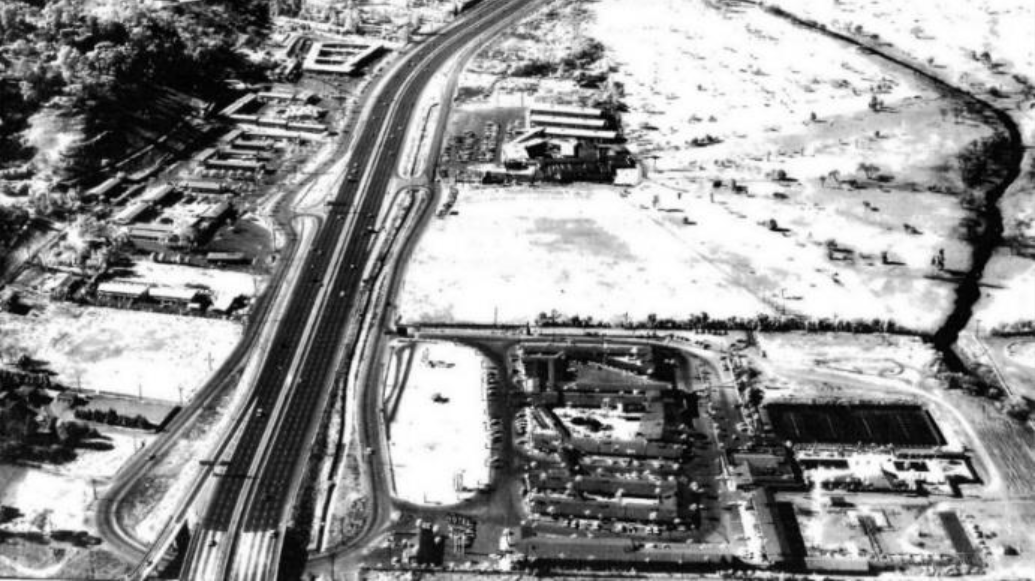


A photograph taken around 1960 captures the scale of the landscape. Looking west at Hotel Circle, the view included the Stardust Motor Hotel, Town and Country, Kings Inn, Vagabond Inn, Mission Valley Inn and Del Webb’s Highway House, later known as the Travelodge.
The Stardust was more than a roadside hotel. The Stardust Hotel and Country Club opened in 1956 with 225 rooms and a 27-hole golf course. The resort also featured swimming pools, tennis, dining and the Reef Lounge, where underwater performances became one of its best-known attractions.
By 1961, the golf course was known as Stardust Country Club, and it hosted professional golf events, including LPGA tournaments.
The hotel later became the Handlery Hotel and Resort. The hotel remains at 950 Hotel Circle North.
The golf course had a different ending. The 27-hole Stardust Country Club closed in September 1996 after the lease on the golf-course property ended. The former golf-course site later became Riverwalk Golf Club.
The Kings Inn was another prominent name along Hotel Circle.

Mission Valley Inn also appeared prominently in the early Hotel Circle landscape.


Another photograph shows the Mission Valley Inn with its steakhouse in 1963, illustrating how these properties were designed to provide more than a place to sleep. Restaurants, swimming pools and other amenities helped turn the roadside motel into a destination in itself.
Its roadside sign was part of the visual language of the era, designed to be seen by motorists passing through the valley.

And then there was Del Webb’s Hiway House.
The property was part of the Hotel Circle group documented in the city’s historic context statement and was later known as the Travelodge.
Taken together, these photographs show something that a list of demolished buildings cannot: Hotel Circle was once a concentrated roadside landscape in which motel names, neon signs, landscaped courtyards and easy parking were all part of the same experience.

Taken together, these photographs show something that a list of demolished buildings cannot: Hotel Circle was once a concentrated roadside landscape in which motel names, neon signs, landscaped courtyards and easy parking were all part of the same experience.
Gateway Inn went from border motel to housing
San Ysidro developed its own version of the motor-motel landscape.
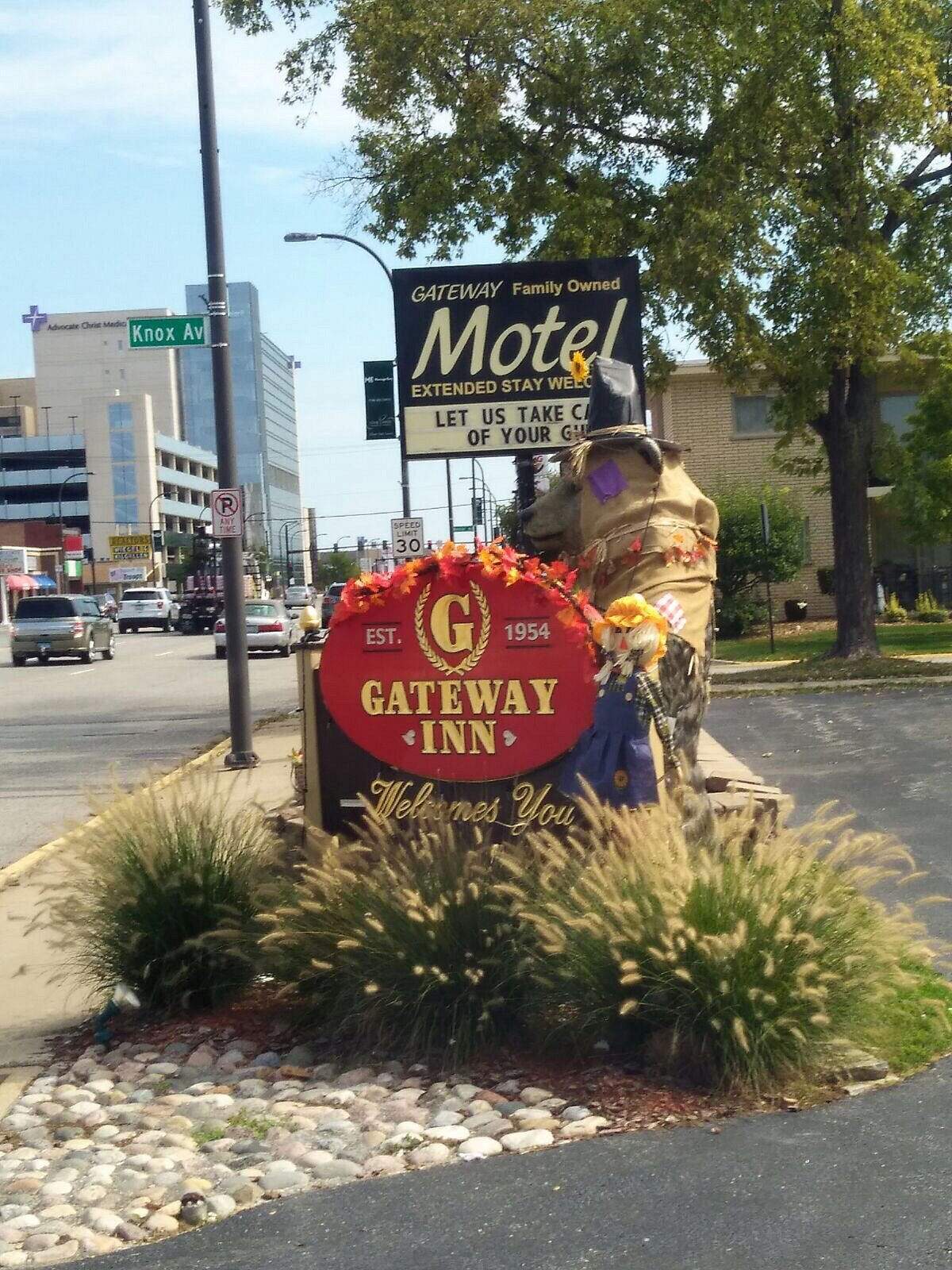
After World War II, the community became increasingly important as a stopping point for tourists traveling toward Tijuana. New restaurants, businesses and motels appeared along San Ysidro Boulevard and old Highway 101.
The Gateway Inn, at 701 East San Ysidro Boulevard, opened in 1956.
Like other San Ysidro motels of the period, it reflected an automobile-oriented form, with units arranged around a courtyard.
But its final years were very different from its beginnings.
The property eventually operated as a single-room-occupancy residence for low-income residents, including families with children. In 2017, the historic motel was demolished.
The Gateway’s disappearance demonstrated how dramatically the role of a roadside motel could change over several decades: A property built to accommodate tourists arriving by automobile ultimately became housing before it was demolished.
Carlsbad shows two very different endings
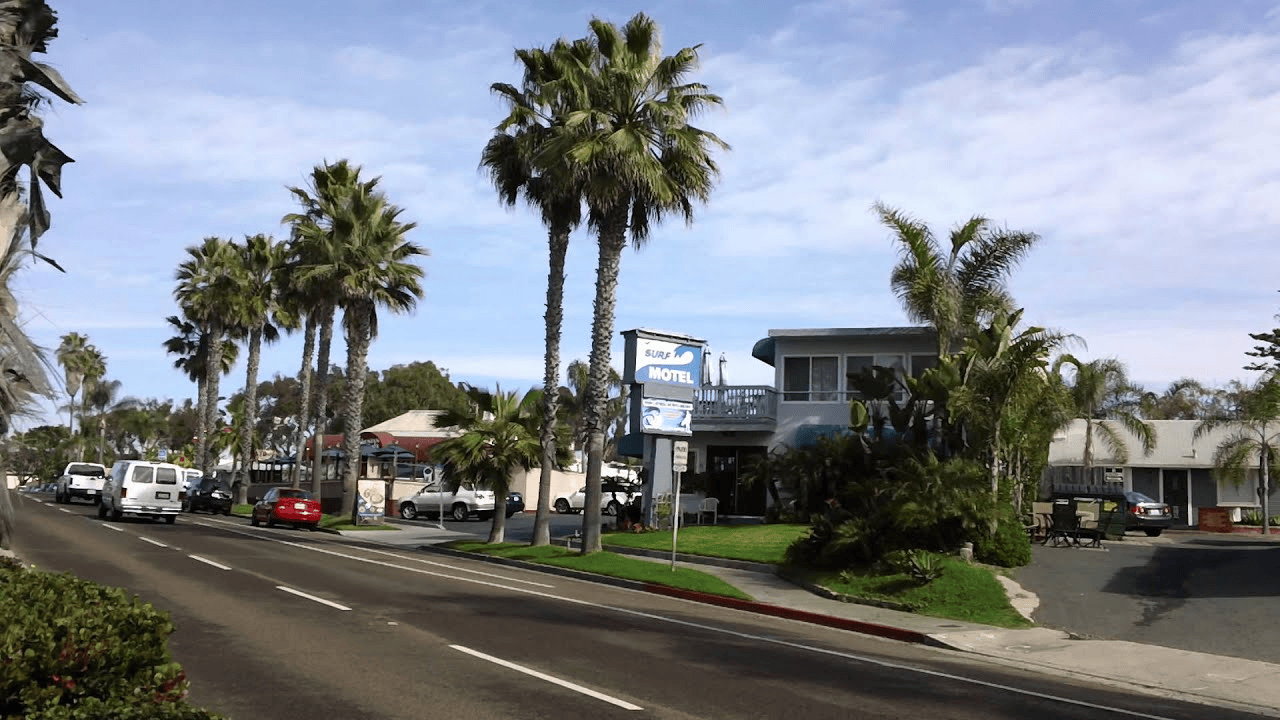
Carlsbad’s roadside motel history also illustrates how the same type of property could have very different outcomes.
The Surf Motel, a 28-room, two-story property on Carlsbad Boulevard, was built in 1968. It closed in December 2015 and was subsequently demolished as plans moved forward for a new three-story Marriott development.
The Scandia Motel, at 2550 Carlsbad Blvd., took a different path. The 23-unit property had fallen into disrepair and vacancy when a new owner took over in January 2016. The property was renovated and renamed Hotel Surf.
The Hotel Surf name did not last. The property continues to operate at the same address as the Scandia Motel.
The two properties illustrate different outcomes for aging roadside motels: the Surf was demolished and replaced, while the Scandia property survived through renovation and a change in ownership.
The Caribbean Motel disappeared beneath Mission Beach housing
Mission Beach had its own collection of roadside accommodations, including the Caribbean Motel at 2613 Mission Boulevard.
A 1955 City of San Diego photograph shows the motel from the south, looking toward Ocean Beach.
The images capture the Caribbean in the middle of the automobile era, when Mission Beach was a major recreational destination and motels competed for visitors arriving by car.
The former motel site is now occupied by Mission Point View condominiums.
The change is typical of the postwar coastline, where older low-rise tourist properties increasingly gave way to larger residential developments.

Oceanside lost Cottage City but kept another auto court
Oceanside’s motel story reaches back even farther.
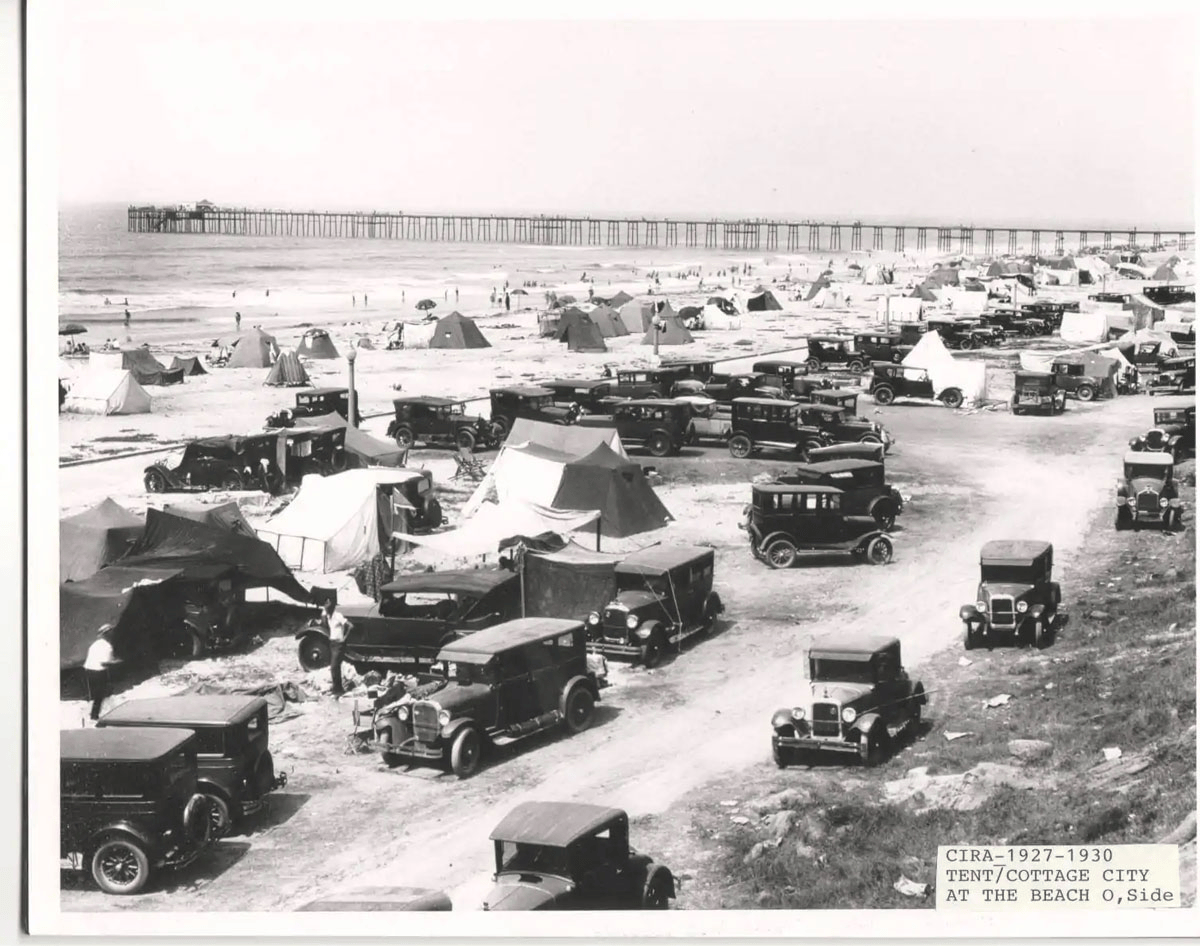
Oceanside’s motel story reaches back even farther.
Cottage City began as Tent City around 1919, when visitors came to the beach with a simpler form of vacation lodging.
In 1922, George Chell purchased Tent City. Three years later, he changed the name to Cottage City and added more substantial cottages, a laundry and a social hall. The cottages included kitchens and garages, reflecting the growing importance of the automobile to vacation travel.
The property stood on the North Strand just south of Sixth Street, now the area around Surfrider Way.

Cottage City eventually disappeared. Visit Oceanside’s historical material notes that the property was torn down prior to 1972.
But another Oceanside auto court followed a very different path.
Travelers Auto Court was built in 1930. The property later became the Wally Johnson Motel and remains the Coast Inn.

Travelers Auto Court, built in 1930. The property later became the Wally Johnson Motel and remains the Coast Inn. (Photo and caption info courtesy of Visit Oceanside/https://visitoceanside.org/)
That progression — Travelers Auto Court to Wally Johnson Motel to Coast Inn — is a useful reminder that not every old motor court vanished. Some survived by changing names and adapting to new generations of travelers
The Sea Bird Motel marked the Highway 101 era
Not every roadside motel was located directly on the beach.
The Sea Bird Motel stood at 2034 South Hill Street along the old Highway 101 corridor in Oceanside.
Its location illustrates the larger geography of roadside lodging. Motorists did not necessarily need to be directly on the waterfront. They needed a recognizable place to stop, a room, parking and convenient access to the highway.
By the middle of the 20th century, the highway itself had become part of the tourist experience, and motels were built to serve the steady stream of motorists moving through communities such as Oceanside.

By the middle of the 20th century, the highway itself had become part of the tourist experience, and motels were built to serve the steady stream of motorists moving through communities such as Oceanside.
El Toreador became one of San Ysidro’s enduring landmarks
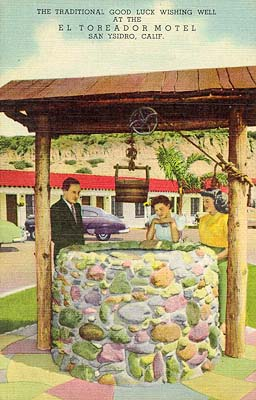
At 601 East San Ysidro Boulevard, the El Toreador Motel represented another variation on the border-town motor hotel.
Construction began in 1948, with contractor Tony Silva overseeing the project. The motel opened in October of that year.
The city of San Diego’s San Ysidro Historic Context Statement describes El Toreador as an especially elaborate project for the community. It attracted tourists traveling toward Mexico as well as visitors associated with the Agua Caliente gambling scene in Tijuana.
Its most memorable feature was its enormous neon sign — a 22-foot-long, 11-foot-high depiction of a toreador fighting a bull.
El Toreador’s history did not end neatly.
The property was designated a San Diego Historic Landmark in 1989. By late 1990, much of the motel had been demolished, while the front building was retained and incorporated into later development.
El Toreador therefore did not survive intact, but part of the original property remained connected to later development.
Its surviving architecture and historic designation preserve a connection to the period when San Ysidro Boulevard was lined with motels serving motorists headed toward the international border.
Now its called El Toreador Plaza, and is a retail center located at 601-631 East San Ysidro Boulevard in San Ysidro. The original Spanish-style motel, built in 1947, was a popular stop for celebrities like Buster Keaton and John Wayne.
The site has since been redeveloped into a retail plaza featuring tenants such as Wells Fargo, Little Caesars, and H&R Block. The plaza offers a variety of shopping and dining options, serving locals and visitors in the San Ysidro area.
The motor lodge era changed with the roads
The old motor lodges did not all meet the same fate.
Rancho 101 occupied a site that had already moved from horse racing to automobile travel and eventually to auto dealerships.
Mission Valley’s Hotel Circle grew into a major concentration of roadside hotels and motels, many of which have since disappeared or changed substantially.
The Gateway Inn became housing before being demolished.
The Surf Motel was demolished for redevelopment, while the Scandia Motel in Carlsbad was renovated, temporarily renamed Hotel Surf and later returned to the Scandia name.
The Caribbean Motel gave way to residential development.
Cottage City was demolished, while Travelers Auto Court passed through several names and survives as the Coast Inn.
Roberts Cottages, built in 1928 on North Strand, also survives as a collection of historic beachfront auto-court cottages.
El Toreador lost much of its original motel setting but retained a physical connection to its past.

The photographs and postcards tell the story particularly well.
They show a period when a traveler could leave the highway, pull into a parking space directly outside a room, read a giant neon sign from the road, and choose among dozens of independently operated motor courts, inns and motels.
The model eventually changed.
Highway construction altered traffic patterns. Land values increased. Larger hotels and residential developments replaced many of the small roadside properties. Some older motels simply became too valuable to remain in their original form.
Read more history stories here. Do you have a story to tell? Send an email to DebbieSklar@cox.net.
Sources:
- City of San Diego, “Mission Valley Historic Context Statement.”
- City of San Diego, ‘Pacific Beach Community Plan.”
- City of San Diego, “San Ysidro Historic Context Statement.”
- City of San Diego, Historical Resources Board report, Sept. 20 2016.
- City of San Diego Digital Archives, “1955 South Mission Beach, Caribbean Motel.”
- Visit Oceanside, “A City Built On Tourism.”
- Visit Oceanside, “The History of Roberts Cottages.”
- San Diego Reader, “Marriott to take place of Surf Motel and Armenian Café in Carlsbad,” by Ken Harrison, Jan. 28 2016.
- San Diego Reader, “Former Scandia Motel becomes Hotel Surf,” by Ken Harrison, Jan. 29 2016.
- San Diego Tourism, “outh Bay’s Historic Heritage.” — El Toreador, 601 E. San Ysidro Boulevard.


