

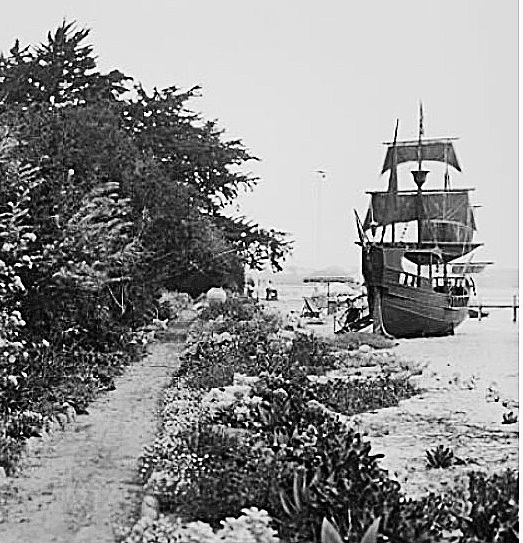
Imagine arriving at a garden party in Pacific Beach in 1929 and discovering a replica of the Mayflower sitting on the beach.
That was the scene at Braemar, the sprawling Scripps estate overlooking Mission Bay, where the ZLAC Rowing Club held its annual garden fete.
Braemar was the Pacific Beach home of Frederick T. Scripps and his wife, Sarah Emma Scripps. By the 1920s, the estate had become one of San Diego’s showplaces, known for its expansive gardens and unusual features.

The property included a log cabin, an adobe house, and an attractive lath house. Its gardens also provided a setting for social gatherings, with lawns and a strip of private beach adjoining Mission Bay.
In 1928, the nearby ZLAC Rowing Club began holding a garden fete at the Scripps estate to raise money for a new clubhouse. The event proved popular and became an annual spring tradition.
Then came the Mayflower.
In April 1929, the San Diego Union announced that Brae Mar, the home of F.T. Scripps, had again been selected as the site of the ZLAC Rowing Club’s annual garden fete. The afternoon would include dancing, a Japanese tea room, fortune-telling and other entertainment.

(photo and caption info courtesy of the San Diego History Center.)
But children had attractions of their own.
The newspaper noted that on the Scripps private beach was a “replica of the Mayflower.” Around the boat, children could take part in treasure hunts, ride ponies, and listen to storytellers.
A photograph preserved by the San Diego History Center shows the unusual vessel sitting on the beach in front of Braemar Manor, providing a remarkable glimpse of the Scripps property nearly a century ago.
The ship was apparently more than a one-day curiosity. In later garden fetes, it was described as a “pirate ship” and remained part of the entertainment for children.
The garden fetes grew into major social events. By 1931, the ZLAC celebration was attracting more than 1,500 guests and had collected more than $1,000 for the club’s new clubhouse. Children enjoyed the pirate ship, along with a puppet show and other attractions.
The elaborate afternoons reflected the social life of San Diego during an era when private estates could become settings for charitable and community events.
The Mayflower replica was just one of the unusual sights at Braemar, but it may be the most memorable today.
Sarah Emma Scripps continued to live at Braemar until she died in 1954. The seven-acre estate was then acquired for redevelopment, and Braemar Manor was razed in 1959. The Catamaran Motor Hotel was subsequently built on the site.
But a piece of Braemar survived. The dining and entertainment wing, added to the mansion in the 1920s, was preserved and eventually relocated to its present site beside Rose Creek, where it is now known as Rose Creek Cottage.

The gardens, mansion, and Mayflower replica are gone, but the San Diego History Center photograph preserves a remarkable moment: a historic-looking sailing ship sitting beside Mission Bay, ready to become the setting for a children’s treasure hunt at one of San Diego’s grandest private estates.
Read more history stories here. Do you have a story to tell? Send an email to DebbieSklar@cox.net.
Sources:
- San Diego History Center — Special Collections. The History Center’s collections include the historic photograph of the Mayflower replica at Braemar Manor.
- Another Side of History — “The Scripps at Braemar.” This extensively researched history of Braemar Manor includes the 1929 newspaper account identifying the replica Mayflower and describing the treasure hunts, ponies, and storytellers planned around it, as well as the history of the ZLAC garden fetes and the eventual redevelopment of the estate.
- Originally Pacific Beach. This book-length history of Pacific Beach includes the Braemar section and references to the replica Mayflower, the ZLAC garden fetes, and the later demolition of Braemar Manor.
- San Diego History Center collection search for Scripps photographs and materials.


