The Defense Department announced awards to five researchers at Scripps Institution of Oceanography for projects that will help scientists characterize waves, improve ocean weather and climate prediction, and analyze acoustics in the deep ocean.
The Defense University Research Instrumentation Program, or DURIP, grants support the development of instruments that have a wide range of military applications. The awards continue a history of collaboration between Scripps and the Navy that dates back to the years immediately prior to World War II, when the Navy would charter Scripps’ sole research vessel.
In recognition of the 70th anniversary of the D-Day invasion, the Navy acknowledged the role played by Scripps researchers in developing ways to time amphibious assaults on Nazi positions using wind forecasts to select periods with favorable surf and swell conditions.
The latest awards went to these researchers:
• Marine acoustics researcher Bill Hodgkiss will design and fabricate a two-dimensional, 256-element hydrophone array for use in the collection of mid-frequency ambient noise and underwater acoustic propagation data in deep water.
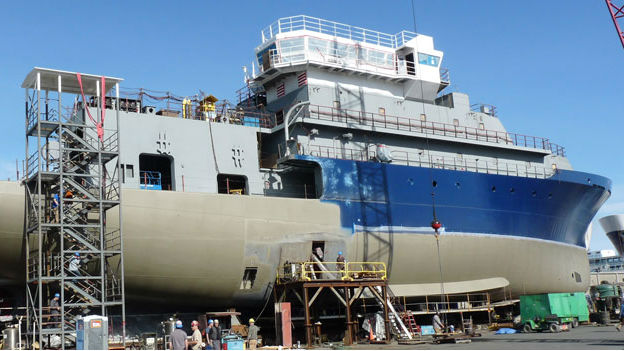
• Bruce Appelgate will install a scientific radar that makes precise real-time measurements of surface waves around the research vessel Sally Ride, which is currently under construction.
• Researcher Eric Terrill received funds to support the Global Wave Buoy Array. The array will be comprised of small, expendable drifter buoys equipped with GPS technology that measures the height, period, and direction of ocean waves and reports these data back to Scripps via satellite.
• Oceanographer Andrew Lucas received funds to develop the real-time telemetry capabilities of the Wirewalker wave-powered profiler. The Wirewalker traverses a vertical wire suspended beneath a surface float, propelled by the energy in ocean-surface waves. This system can profile a variety of ocean phenomena indefinitely.
• Physical oceanographer Rob Pinkel received funds to significantly upgrade an existing Hydrographic Doppler Sonar System mounted on the hull of Scripps research vessel Roger Revelle.
Three members of Congress from the San Diego region, Susan Davis, Duncan Hunter and Scott Peters, issued congratulatory messages.
“I congratulate the researchers at UC San Diego for their DURIP awards,” Davis said. “This federal funding will strengthen innovation, and will allow these researchers to develop new technologies and improve our understanding of the oceans in support of our nation’s defense.”
“UC San Diego’s much-deserved awards will not only allow scientists to develop cutting-edge technologies and advance defense research, but will also support the San Diego region’s blue economy,” Hunter said. “The San Diego region is home to a vibrant maritime economy that is enhancing our country’s maritime safety and security, and these DURIP awards will go a long way to supporting that effort.”
“San Diego is a global leader in defense and science technology innovation, and UC San Diego is a key player in our region’s success. I applaud these researchers on their recent DURIP awards,” Peters said. “These awards will support the development and acquisition of state-of-the-art instrumentation, while advancing America’s competitiveness and speeding up the transition of new technology to practical defense applications.”