
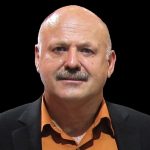

Supporters lined up for photos, volunteers shuffled through stacks of campaign flyers and television cameras waited near the stage as Steve Hilton greeted voters in Huntington Beach.
The scene reflected both the enthusiasm of his supporters and the challenge ahead. Hilton is running for governor in a state where Republicans have not won a gubernatorial election since Arnold Schwarzenegger’s 2006 reelection. Democrats have controlled statewide politics for nearly two decades.
Hilton believes growing frustrations over affordability, homelessness and public safety have created an opening.
“Millions of people in California are tired of the cost of living, the chaos, the poverty,” he said. “They want change.”
Though well known in conservative media circles, Hilton remains unfamiliar to many voters. Born in the United Kingdom, he advised former British Prime Minister David Cameron before moving to California, where he became a television host, author and political commentator.
He still carries a distinctly British accent and the quick pace of a veteran broadcaster. In interviews and campaign appearances, he repeatedly returns to what he sees as California’s core problem: government is spending more while delivering less.
His signature proposal would exempt the first $150,000 of income from California’s state income tax. To offset lost revenue, he supports spending cuts, eliminating the high-speed rail project, reducing government bureaucracy and cracking down on Medi-Cal fraud.
“We’ve doubled state spending over the last ten years,” he said.
Housing is also central to his message. Hilton argues that regulations, fees and lengthy permitting processes have slowed construction and pushed homeownership further out of reach for working families.
“We’re spending more money. We have more regulations. Everything is worse,” he said.
That theme surfaced again during a recent visit to MacArthur Park in Los Angeles. Walking past street vendors, small businesses and homeless encampments, Hilton spoke with residents who, he said, were less interested in partisan politics than in the problems they encounter every day.
He expected tough questions about immigration. Instead, many conversations focused on homelessness, drug addiction, public safety and frustration with government responses to persistent problems.
For Hilton, the state’s homelessness crisis represents a broader failure of public policy.
“This cannot continue. We have to take action. We have to help people rebuild their lives. They cannot be living only for their next dose,” he said.

His proposal calls for expanded mental health and addiction treatment, paired with stricter enforcement against encampments in public spaces.
“We have to get people off the streets, away from drugs, and into mental health care and job training,” he said.
Immigration is another topic that comes up frequently on the campaign trail, particularly in communities where Republicans often face skepticism.
Hilton points to his own background. He is an immigrant and the son of Hungarian immigrants who settled in Britain. He rejects the idea that supporting stricter immigration enforcement is incompatible with supporting immigration itself.
“In fact, I’m in favor of immigration. I recognize the contributions immigrants make, but we all want immigration to be orderly,” he said.
He argues that California should continue welcoming legal immigration while consistently enforcing immigration laws.
Hilton also advocates a tougher approach to crime, greater support for law enforcement and reforms at the Department of Motor Vehicles, one of the campaign talking points that often draws laughs from audiences.
“Everybody hates going to the DMV,” he said with a smile.
On education, Hilton focuses less on funding levels and more on results, arguing that students should be reading at grade level by the end of third grade.
“It’s not about the money. It’s about what you do with it,” he said.
As Election Day approaches, Hilton faces a political reality he readily acknowledges. California remains a heavily Democratic state, and Republicans have struggled for years to win statewide office.
Still, he argues that concerns over affordability, housing costs, homelessness and public safety have created an opportunity for a candidate promising a different approach.
Whether voters agree will become clear on Nov. 3. For Hilton, his campaign is built on the belief that enough Californians are dissatisfied with the state’s direction to look beyond party labels and consider change after nearly two decades of Democratic control.


