

Two organizations have joined forces to seek an injunction against the city of San Diego over the San Diego Police Department’s use of automated license plate readers.
They’re asking the court to make the city stop using ALPRs and terminate contracts associated with the technology, while uninstalling all streetlight cameras that operate as readers and deleting all the stored data that has been collected by the systems.
On Wednesday, the ACLU Foundation of San Diego & Imperial Counties and the Partnership for the Advancement of New Americans, the plaintiffs in the case, stood in front of the Hall of Justice in Downtown San Diego to announce the suit.
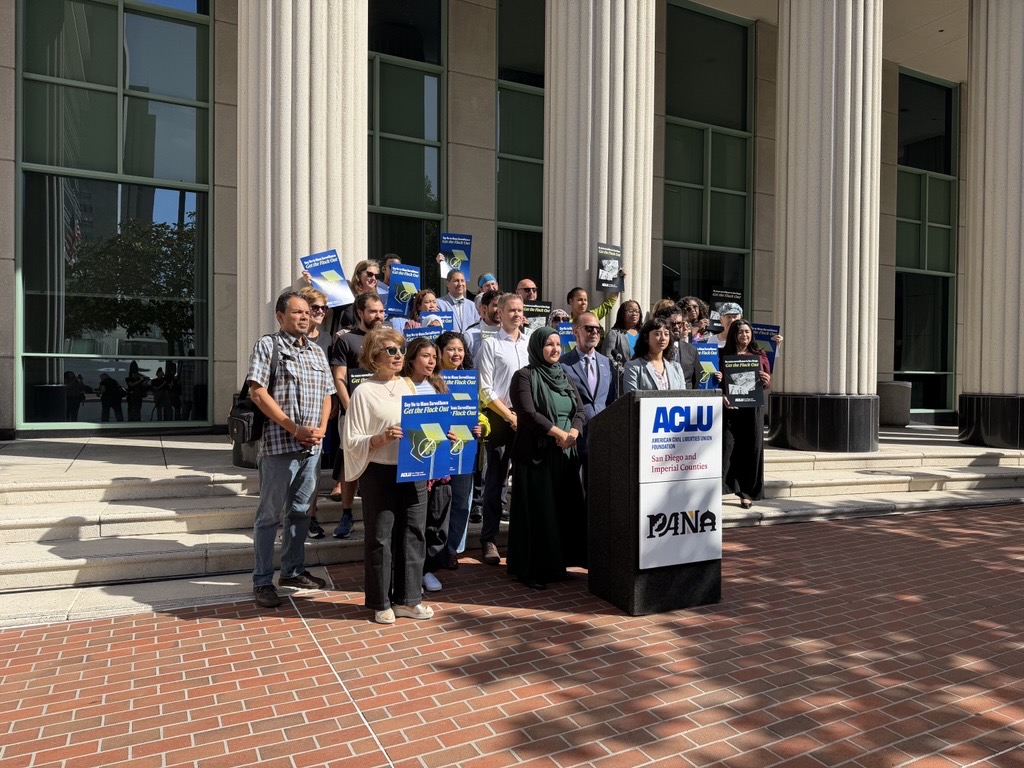
The plaintiffs argue that the technology, due to the high density of cameras throughout the city of San Diego, violates the right to privacy protected in the California constitution.
By retaining ALPR data for a month-long period, the plaintiffs claim SDPD can create a pattern based on people’s movements throughout the city – and others with whom they associate too.
“And let’s be clear: These cameras do not just take an individual snapshot of an individual license plate so that somebody’s car can be looked up later,” Frederick Carroll, legal director at the ACLU foundation, said.
“They work like every other camera. They contain the whole image that the lens sees. So that includes make, model, color, license plate, bumper stickers, identifying insignia, the ball cap you’re wearing when your window’s down, the tattoos you’re showing when your arm’s out the window.”
While the speakers highlighted the technology’s capabilities, they were also quick to point out its shortcomings.
They cited a Times of San Diego report, also included in the lawsuit, that found a man had been wrongfully identified as the perpetrator of a crime by a Flock camera, and spent time in jail despite being innocent.
Homayra Yusufi, a senior policy strategist at PANA, said that despite being touted as a tool to be used in an emergency, ALPRs did not direct law enforcement toward the scene of May’s fatal mosque shooting in time to prevent it.
“My community was ravaged in May after white supremacists shot and killed members of my community. On that horrific day, ALPRs were not just an affront to our democracy, but they were ineffective,” she said.
“So when you compile the fact(s) that these are ineffective technologies and who they are surveilling and targeting, we have to recognize that this technology is being used against us, not for us.”
Carroll told Times of San Diego that to their knowledge this is the only local lawsuit targeting a city in an attempt to discontinue its use of ALPRs under the California constitution. He said, though, that there are complementary efforts, including a case in Northern California called Siren v. San Jose.
Seth Hall, of the Trust SD Coalition, formed in 2019 to push back against and promote responsible use of the smart streetlights in wide use across San Diego, said he believes the track the city is on is a slippery slope.
“When’s it going to be a big enough deal? Hall said.
“Is it when the skies are filled with drones? When the police are able to pull the RIng doorbells, and the smart streetlights and the Flocks and the drones together to create a god’s eye view? Is that too much? For me the line has been crossed a long time ago.”
The San Diego City Attorney’s Office declined to comment on pending litigation.


