

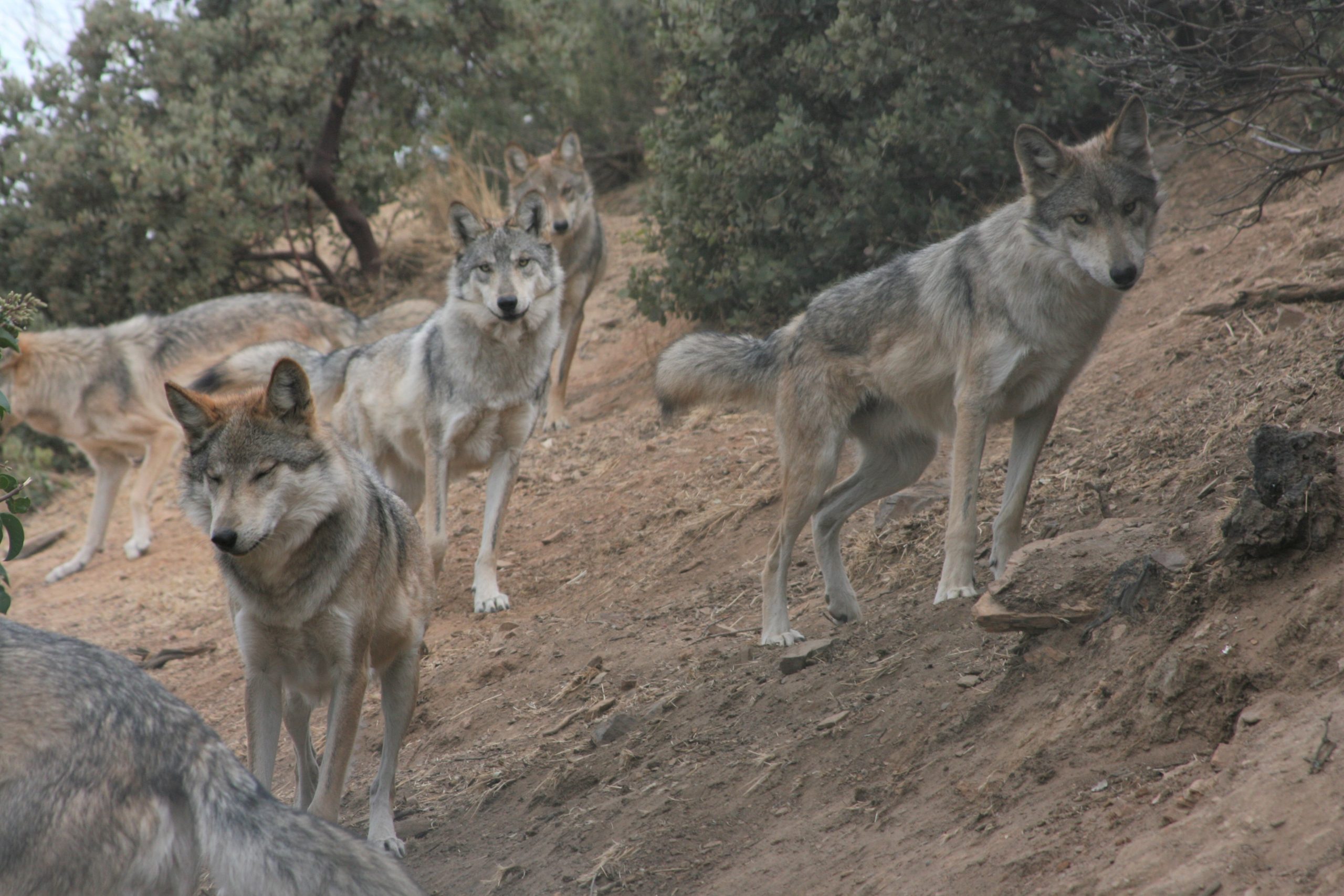
(Photo courtesy of the California Wolf Center)
President Donald Trump signed an executive order this month calling for re-evaluation of the endangered-species status of wolves, potentially affecting decades of conservation efforts.
San Diego might not seem like a region with a lot riding on that decision, but the California Wolf Center in Julian has been in the teeth of that fight since it opened in 1977.
The center recently announced its largest expansion in 50 years, but as it looks to invest millions in a new campus, it is suddenly facing uncertainty over the future of federal protections for wolves, including the possibility that their endangered-species status could be reduced or removed.
“We want to work towards coexistence and not only teach people about wolves, but teach people how to think about wolves differently, and how to see them as important parts of the ecosystem,” said Jacob Keeton, the director of education and engagement at the California Wolf Center. “How can we support the people that live most intimately with the wolves in the landscape?”
Tensions with ranchers
Trump dubbed his executive order “Supporting America’s Ranchers.” That’s an acknowledgement of the long-standing tension between wolf conservation efforts and ranchers who see the animals as a threat to their livelihood.
The president’s authority allows him to direct the secretary of the interior to re-evaluate the status of gray wolves and Mexican wolves — not directly change the status himself.
In order for Secretary Doug Burgum to begin the process of downlisting or delisting the wolves, the government needs to first meet the criteria under the Endangered Species Act.

To delist or downlist a species, the U.S. Fish and Wildlife Service assesses populations and recovery achievements in eliminating or reducing threats. Gray wolves became endangered largely due to human activities, including excessive hunting, trapping and habitat loss.
Gray wolves have been naturally returning to California over the past few years — an achievement credited to their protection as an endangered species. The California Department of Fish and Wildlife said in 2024, the return of the wolves is a reminder of their “intrinsic” value in the ecosystem.
“The return of wolves to California is an important example of what long-term conservation can accomplish,” Christine Barton, the executive director of the California Wolf Center, said in a written statement. “It is also an example of why coexistence matters.”
California Wolf Center promotes conservation through education, advocacy, managed care, species recovery efforts and partnerships with other conservation organizations. It works to support the natural return of wolves to California by encouraging coexistence, protecting habitats and increasing public understanding of wolves as part of the ecosystem.
State actions
Even if the Trump Administration does delist the species, Keeton said it’s not an immediate “call to action.”
“It’s one of those things that takes it from the federal purview and puts it back onto the states,” he said. “With a lot of wolves, states have already got a lot of their own regulations about how wolves can be managed.”
Gray wolves are protected as a recovering endangered species by the California Department of Fish and Wildlife. California law protects gray wolves from actions that could harm, capture or kill them.
Ranchers in the state are encouraged to use non-lethal deterrents to keep wolves away from livestock.
In 2025, around 155 cattle were killed or injured in California by wolves. The number rose to 197 when adding probable wolf attacks in the state, according to Inside Climate News.
Keeton said wolf-related livestock losses are generally limited and concentrated in specific areas, making targeted, nonlethal deterrents more effective than broad legislation.
“When you look at the sort of total numbers of wolf conflict with producers in the wild, wolves really only are a small sliver of mortalities,” Keeton said. “When (the location is) focused like that, which wolf predations tend to be, then broad sweeping legislation doesn’t really address that.”
Farming and ranching counties backed Trump by an average of 77.7% during the 2024 election, but since his second term started, Trump has been slammed with criticisms over rising costs that have hit farmers hard.
The executive order isn’t the only Republican attempt to solidify rancher support ahead of the midterms.
Rep. Paul Gosar, R-Arizona, introduced a bill to remove the Mexican wolf’s separate endangered-species listing, ending related federal rules and limiting the U.S. Fish and Wildlife Service’s ability to consider Mexican wolf populations in Mexico when managing or determining the U.S. population’s recovery status.
“Millions of taxpayer dollars have been spent to recover a species that is wreaking havoc on communities that already have to deal with intense weather conditions and other natural resource challenges,” said Kaitlynn Glover, the National Cattlemen’s Beef Association executive director of natural resources, in a press release. “The U.S. government has better uses for tax dollars than feeding recovered wolves from food caches and then shooing them away.”
The California Wolf Center joined the AZA SAFE Mexican Wolf program to protect Mexican gray wolves that roam Arizona, New Mexico and California. The center has bred the animals, housed wolves removed from the wild and participated in wild releases.
Keeton pointed out that even if California continues to protect wolves under state law, that wouldn’t mean anything in nearby Southwestern states.
“Wolves don’t really know where these protections begin or end,” Keeton said.
The California Wolf Center’s expansion into a new property marks its 50th anniversary. During the past half a century, Keeton said “we’ve played different roles” when it comes to conservation and protection efforts.
The center hopes to expand its mission to protect other native California predators at the new property at Mariposa Ranch. The center launched Guardians of the Wild, an education and financial campaign, to fund the mission.
Keeton said while this executive order could be a hit to some of the center’s efforts, science is on their side.
“If there is a silver lining (to the executive order), it has brought wolves back into the spotlight,” he said. “Hopefully based on the best available science that I’ve seen, it doesn’t look like the Mexican gray wolf is due to be delisted.”


