


For the fifth year, Aro/Ace San Diego will march in the Pride Parade.
For the support group turned vibrant community, participating in Pride festivities is vitally important for representation, visibility and education on asexuality, and the even lesser-known aromanticism.
“A lot of people along the parade route were so amazed to see us, and so surprised to see us,” said Max Christenfeld, a facilitator of Aro/Ace San Diego. “We would get people in the crowd wearing ace or aro flags pointing to us, and just being so overwhelmingly excited because they had never seen a group, an ace/aro group, at Pride.”
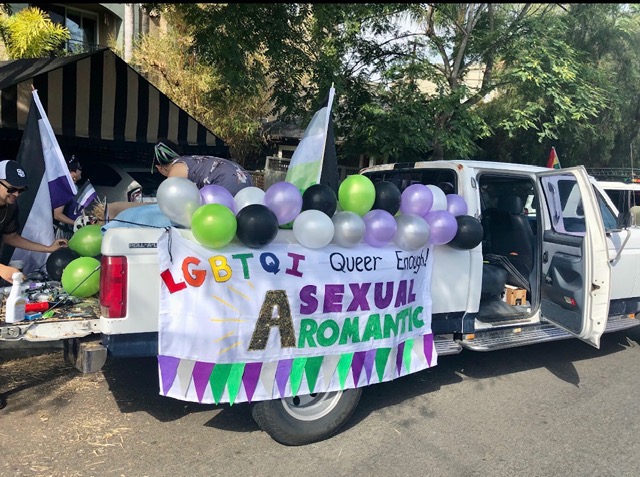
Marching and hosting a booth is a heavy lift for the scrappy community group, which has limited institutional support. None of its members have backgrounds in nonprofit management or similar fields.
But for the Aro/Ace group, it’s worth it.
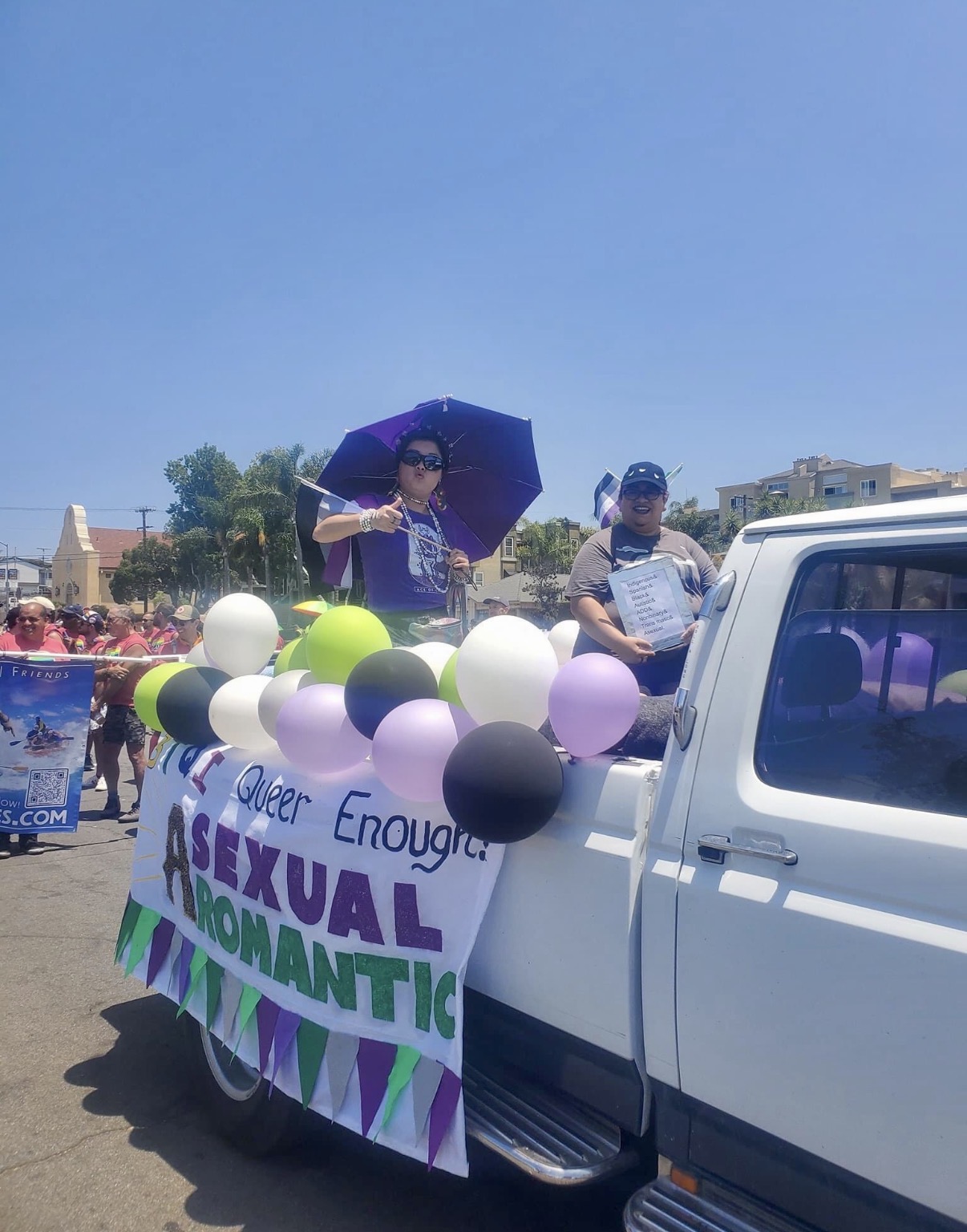
“Everything that we’ve built is like handmade, customized, painted,” said Rhyse Tamez, a former group leader. “But we still got to watch how much of an impact we made on our community.”
The A in LGBTQIA gets dropped often — literally to shorten the acronym as well as figuratively. That A does not stand for ally; it represents agender, aromantic and asexual people.
Two of those groups, united and often overlapping, first organized to participate in the parade and festival in 2022 with a truck, signs and banners celebrating Aro/Ace San Diego. It was the big public debut of a support group that had been meeting virtually for a year and a half through the website Meetup.
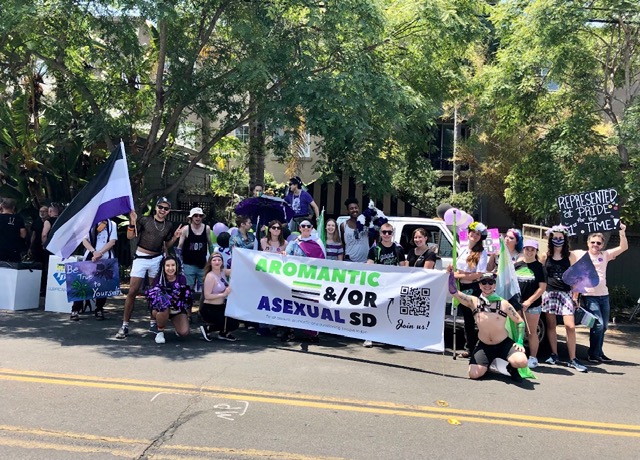
Asexual and aromantic people, colloquially known as ace or aro, have either no romantic or sexual attraction, or it is rare or conditional. Aro/ace people champion social support networks that do not rely on heterocentric nuclear families, instead demonstrating the power of platonic friendships.
Although the asexual and aromantic experience is not new, the language to describe it is. That can lead to dismissive attitudes from outsiders. But for those who adopt the label, it can also be freeing to find a word for their experience — and find an entire community.
“There’s so many ace people in San Diego. So many, especially overlapping with (the) trans community,” Tamez said. “You’d never know it, because no one’s given them a chance to be visible, right?”
Group founder Shane Cricket attended Pride events for years without ever seeing his identity represented in the parade. Even in LGBTQ+ support groups Cricket attended, few people knew about aro/ace experiences.
“I would frequently ask if anybody had ever met anybody or come across the term asexual, and I was always met with silence,” Cricket recalled. “I was just met with silence on an entire sexuality every time.”
Cricket founded the support group to fill an absence in his own life. Despite the silence, he refused to believe he was the only aromantic and asexual person in San Diego, a region of 3 million.
His suspicion proved true. The pandemic gave him the time and opportunity to organize virtual meetings. When the group met in person for the first time at Balboa Park’s Japanese Friendship Garden in 2021, around 25 people showed up. Now on its social accounts, members can join from around the world, boosting their numbers to more than 300 people online

“It, like, exploded. We all don’t know each other, but we all found this community,” said Cricket, who now lives in North Carolina. “It’s very validating, knowing that this was a community that was not only wanted but needed.”
The group eventually moved off Meetup to Discord and became an official program of the San Diego LGBT Community Center. It remains volunteer-led and volunteer-run, with new leaders putting on multiple events per month.
The community they formed is particularly important since many members do not want or have partners. Those romantic relationships form a societal core around which revolve legal, financial, elder care and housing systems.
“You still need people to show up for you,” Christenfeld said. “We show up for each other.”
At the Pride Festival, they will show up for the community, offering education resources and inviting new people to join the group. Parents seeking to better understand their kids come, but there have also been serendipitous encounters of self-discovery from older adults who can finally name their experience.

Once at the booth, a middle-aged woman from Las Vegas started sobbing. After enduring decades of pressure to get married or even date, she finally found a word to explain why neither was right for her.
“I’m not broken,” was a litany among interviewees on their discovery journey.
“I thought something was broken,” said Azure Partridge, a longtime group member, on trying to understand their sexuality before learning the terms asexual and aromantic in their 20s.
“It was so freeing learning that I wasn’t broken, that it wasn’t just me, and that I didn’t have to push myself. That I could just say no.”


