

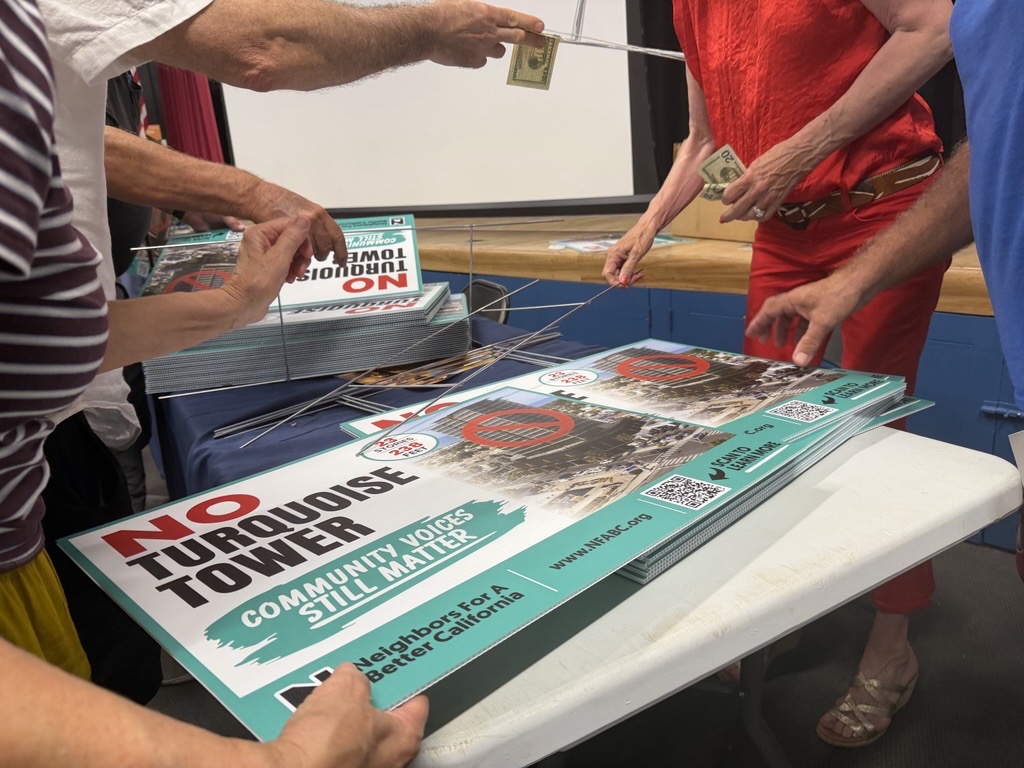
PACIFIC BEACH – An evening town hall featuring Rep. Scott Peters — who serves the 50th district, which spans the coastal areas, then veers into Escondido — brought out residents who simply do not want to see a 23-story development in Pacific Beach.
Residents crammed into Crown Point Junior Music Academy on Wednesday, fanning themselves with leaflets from Neighbors for a Fair California that read “23 Stories. 239 Feet.” The fliers referred to the height of the Vela Project, known locally as the Turquoise Tower.
The project is in its sixth cycle of city staff review. Planners have requested revisions from the developers for nearly three years now. To put it lightly, some residents are not happy with the proposal.
Peters told the room that the meeting, also convened by the Pacific Beach Town Council and Pacific Beach Planning Group, was spurred by a “mean letter” from a resident named Tom, who was present in the room and stood up. He said the letter detailed that he did not vote for Peters, precisely because of the fact that a project like this could be considered.
“I’ve really recognized this over the years in elected office, you know when a community is pissed off,” said the former council member, council president, now a congressman in his seventh term.
As a result, Peters sent a letter to Mayor Todd Gloria personally asking him to deny the project’s application.
While he detailed his opposition to the project, he clung to a core belief he has adopted that guides his legislative goals: California needs more housing.
The crowd, though, wasn’t buying it.
During the primary question-and-answer section of the town hall, one question arose, drawing applause – whether Peters would ever rethink his position that increasing the housing supply brings down prices.
He answered that it’s a matter of supply and demand.
That answer didn’t appease the angrier members of the crowd, but part of the temperature of the room could be attributed to the demographics, the majority of those in attendance being well above their 40s.
“Look, I think these are the homeowners trying to protect their neighborhood,” Peters told Times of San Diego.
“I think what I wanted to say to them is that young people feel like we’re pulling up the ladder behind us,” he said, explaining that this disconnect means that things must change, namely regarding how San Diego approaches housing.
One solution he proposed to increase home ownership was incentivizing older San Diegans to sell their homes through higher exemptions on capital gains taxes. Another was the 21st Century Road to Housing Act that Congress passed in June, specifically Title 9, the portion that places restrictions on how much housing stock corporate entities can own.
Another question for Peters was why he has thrown his support behind SB 79, a state law that incentivizes development near transit. The crowd wasn’t particularly interested in his answer – that the legislation gives people the chance to be in a position to live near and take advantage of taxpayers’ billion-dollar investment in trolley cars and transit stations.
One person asked how to rein in density when the infrastructure to support it isn’t present. The crowd was more receptive to his answer on this one: current city procedure, not keeping development impact fees within the specific community where the project is located, is a bad idea.
He gave the example of a project he supported as the District 1 council member. He set out to change La Jolla Boulevard from a six-lane road, and the project met with considerable opposition. After community input, the stretch of road now includes a series of roundabouts that slow down drivers. He said those roadway improvements were funded by developer impact fees from units developed there.
“We want to build housing that matches the neighborhood, that’s a credit to the neighborhood. And that’s what we did in Bird Rock,” Peters said, adding that the accomplishment came about through engaging neighbors and allowing them to provide their own leadership.
“That’s what has to happen here, he said. “That dynamic is not happening here yet. These people are ready to have that conversation, but they haven’t been invited.”
One way to extend that invitation, he said, would be for them to be able to work on their community plan, which has not received a complete update since 1995. But that must come with assurances that it will be respected while, he said, doing the work of providing more housing.
It was clear those who attended were frustrated. They shouted and booed when Peters made comments they did not like and clapped when he echoed their beliefs.
Yet after the meeting, Peters said he understood the frustration.
“These people are desperate to have a conversation about what’s going on. No one talks to them. They feel like someone at a counter signed off on this, and they had no say.”


