

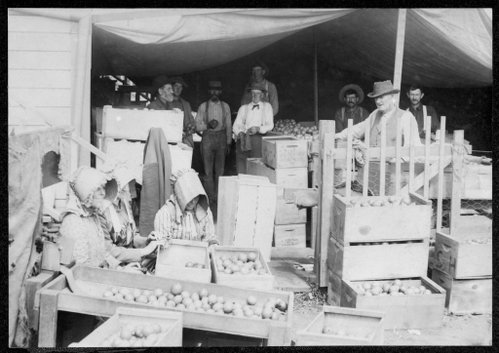
It is hard to picture Pacific Beach as a place of lemon ranches.
In the late 1890s, much of the neighborhood was covered with young lemon trees, and growing and shipping the fruit had become an important part of the community’s economy.
The transformation began after the San Diego College of Letters closed in 1891. Some families who remained in Pacific Beach turned to fruit cultivation, particularly lemons. In 1892, the Pacific Beach Company encouraged agricultural development by dividing much of the area into roughly 10-acre “acre lots.” Owners plowed the land, installed irrigation pipes, and planted thousands of trees.
By 1895, lemon ranching was well established.
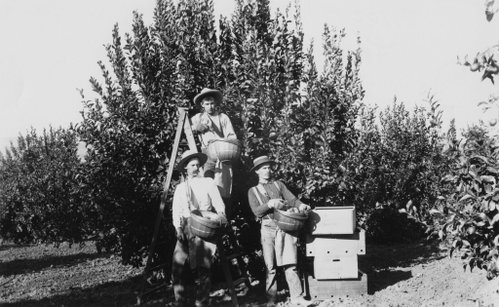
The industry grew quickly. In 1897, Pacific Beach shipped its first full carload of lemons east to Duluth, Minnesota. The following year, grower Franklin W. Barnes reported about 25,000 lemon trees in bearing. Growers produced Lisbon, Villa Franca, and Eureka varieties, with thousands of boxes shipped to distant markets.
The lemons also needed to be prepared for shipment.
In 1896, lemon grower Sterling Honeycutt acquired property that included the Pacific Beach Company’s hotel and dance pavilion. The buildings were moved from the beach to a site near what is now Hornblend and Lamont streets. The former dance pavilion became a lemon curing and packing house, with a railroad siding where boxcars could be loaded.
By 1900, the scale of the industry was striking. A San Diego Union account described roughly 300 acres of lemon groves in central Pacific Beach, with orchards ranging from about 2½ to 10 acres. During the preceding year, the groves had produced 30 carloads of lemons.
Photographs from the period show how different the landscape was. The packing plant stood among lemon orchards and early Pacific Beach buildings, while other images document ranches near what are now Garnet Avenue and Jewell Street.
But the lemon boom did not last.
G.W. Brooks, writing for the San Diego History Center, recalled that Pacific Beach had “lemon orchards” and “a lemon packing plant” for years before the business was undermined by problems involving duties on Italian lemons. The lemon business eventually ended, followed by increased subdivision and the destruction of the orchards.
Land once measured in acres of lemon trees was increasingly divided into residential lots.
The orchards disappeared, and Pacific Beach evolved into the residential and commercial neighborhood recognizable today.
For a community now associated with beaches, nightlife,e and busy streets, its lemon-growing years offer a strikingly different picture: Pacific Beach was once a place of citrus groves, packinghouses, and railroad cars carrying local lemons to markets across the country.
Read more history stories here. Do you have a story to tell? Send an email to DebbieSklar@cox.net.
Sources:
- San Diego History Center, “Whatever Happened to Izard Street?” by Zelma Bays Locker.
- Another Side of History, “PB’s Lemon Era 1892–1906,” May 22, 2021.
- Another Side of History, “Pacific Beach Life — 1894,” March 11, 2023.


