

Along the rocky edges of Point Loma, the ocean has always been close enough to shape daily life. Today it is defined by tide pools, marine reserves, and protected kelp forest waters. But in the late 19th and early 20th centuries, these same waters supported a quieter, largely overlooked coastal economy built around shellfish — especially abalone.
The abalone trade was never centered in one visible industry in Point Loma, existing instead as part of a multilayered coastal system that included Indigenous harvesting practices, small-scale commercial fishing, and immigrant fishing communities working along the edges of San Diego Bay and nearby shorelines such as La Playa.

Kumeyaay coastal communities harvested a wide range of shellfish from the rocky intertidal zones around Point Loma as part of broader seasonal use of marine resources along the coast. These practices reflected a sustained relationship with the shoreline’s shifting tides, reefs, and marine ecosystems.
By the mid-to-late 1800s, that coastal economy began to change as commercial fishing expanded across San Diego Bay. One of the earliest and most important fishing settlements in the region developed at La Playa on Point Loma, where Chinese immigrant fishermen established a small coastal village.
From this base, they supplied much of San Diego’s fresh fish and participated in drying and preparing seafood for export, including abalone shipped to regional markets and to Chinese communities in California and abroad. Their work helped establish an early commercial fishing network that shaped San Diego’s maritime economy.

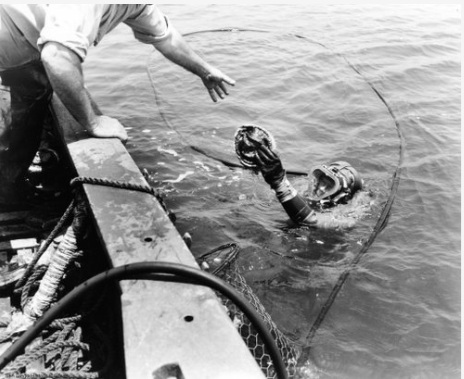
At the time, abalone populations along Southern California’s coast were still relatively abundant, at least compared to later decades. Harvesting was labor-intensive and done close to shore. Divers and shoreline collectors pried abalone from rocky reefs, then processed the meat for transport. It was commonly salted, boiled, or dried so it could be stored and shipped over long distances.
These methods were used widely along the California coast in the early development of the abalone trade, where immigrant labor played a key role in building the industry.
Point Loma’s geography supported this coastal economy. The peninsula sits between San Diego Bay and the open Pacific, where rocky reefs and kelp forests create habitat for marine life including abalone, lobsters, and fish. Offshore kelp forests also supported early scientific observation and later conservation research.
This pattern extended beyond Point Loma. Along other rocky stretches of the San Diego coastline — including La Jolla, Ocean Beach, Sunset Cliffs, and areas near Cabrillo — abalone were gathered through both Indigenous harvesting traditions and early commercial fishing activity. Any place where shallow rocky reef met kelp forest provided similar conditions for nearshore collection.

Over time, increased commercial demand placed pressure on abalone populations. Through the 20th century, harvesting combined with environmental change — particularly shifts in kelp forest health — contributed to widespread decline along the Southern California coast. In many areas, populations eventually collapsed or became heavily restricted under modern conservation regulations.
As military development, residential expansion, and marine protection policies reshaped Point Loma, access to the shoreline changed. Large portions of the coast and offshore waters came under regulation or restricted use, altering how the area functioned as a working coastline.
These days, abalone along the Southern California coast are no longer part of a commercial fishery, and recreational harvesting is tightly limited or closed in many areas due to long-term population decline. Conservation efforts focus on restoring kelp forest ecosystems, which remain essential habitat for abalone and other nearshore species.
The La Playa shoreline, once an active landing and fishing zone, now sits within a landscape defined by residential and military boundaries. Offshore, the kelp forest continues to operate as one of California’s most closely studied marine ecosystems, shaped now by regulation, monitoring, and conservation science.

The abalone economy that once developed along Point Loma was defined by access to the shoreline — rocky reefs, tidal zones, and nearshore waters that supported both subsistence and small-scale commercial harvesting. Over time, that system narrowed as ecological conditions and human use of the coast changed.
Read more history stories here, and do you have a story to tell? Send an email to DebbieSklar@cox.net.
Sources:
Point Loma historical fishing and La Playa Chinese fishing village documentation (Point Loma Association historical markers)
Channel Islands / California abalone harvesting history (U.S. National Park Service)
Point Loma kelp forest ecosystem and marine use (Scripps Institution of Oceanography / UC San Diego research archives)
Cabrillo National Monument / California coastal use and Indigenous marine harvesting context (California Department of Fish and Wildlife MPA documentation)


