


Mt. Helix is one of those East County landmarks people think they already know — drive up, take in the sweeping view, snap a photo, and head back down the winding road.
But the hill’s story is not just what unfolds at the overlook. It is layered into its name, its transformation, and the generations who turned a quiet summit into one of the Mt. Helix area’s most recognizable gathering places near La Mesa.
Here are seven stories hidden in plain sight at Mt. Helix.
1. The summit was once an open hillside


Before it became a landmark, Mt. Helix was part of the East County foothills — open, undeveloped terrain overlooking a region that was still transitioning from rural land uses into early residential development. Its elevation made it a natural vantage point long before it became a formal destination.
2. The cross became its defining symbol

(Photo and caption info courtesy of the San Diego History Center)
The Mt. Helix cross was installed as part of a 1924–1925 memorial development honoring Mary Carpenter Yawkey. Positioned above the amphitheater, it quickly became the most visible feature of the site and remains one of East County’s most recognizable nighttime landmarks. Over time, it has also taken on broader community meaning beyond its original memorial context, according to reports.
3. A memorial that shaped the park

The amphitheater was developed during the same 1924–1925 period as part of the memorial landscape, funded by the Yawkey family in honor of Mary Carpenter Yawkey. The design used the natural slope of the hillside to create an outdoor gathering space oriented toward sweeping East County views.
4. Easter sunrise services began before the monument
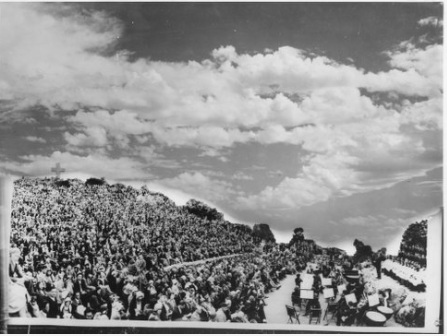

Easter sunrise services at Mt. Helix date back to 1917, when early gatherings were held on the open hillside long before the amphitheater or cross were constructed. These services helped establish the summit as a regional gathering place and laid the groundwork for its later development into a formal outdoor venue.
5. The landscape is shaped by regional growth
The Mt. Helix area developed during a broader period of early 20th-century growth in East County, when foothill communities such as La Mesa were transitioning from agricultural uses into residential neighborhoods. The evolution of Mt. Helix reflects that larger regional shift.

6. Community stewardship keeps it alive
Today, Mt. Helix Park is maintained by the Mt. Helix Park Foundation, a nonprofit organization responsible for preserving the amphitheater, cross, and public access areas. The site is sustained through private donations and community support rather than ongoing municipal funding.
7. The amphitheater was designed for sound, not external amplification

One of the most overlooked features of the site is its natural acoustics. The amphitheater was designed to take advantage of the hillside’s bowl-like shape, allowing sound to carry across the gathering area long before microphones or amplification systems were available.
The name and the snail

The origin of the name “Mt. Helix” is commonly associated with the land snail genus Helix (now often classified under species such as Cornu aspersum) found in Southern California. While no single definitive historical record confirms the naming, the explanation appears in local historical references and interpretive materials, reflecting how early place names were often drawn from natural features observed in the landscape.
A place shaped by time and memory

Mt. Helix remains a landmark shaped not only by its view, but by its layers of use — memorial, gathering place, and community space. What looks like a simple overlook is in fact a hillside shaped as much by people as by geography, where history continues to sit quietly beneath every sunrise service and evening light over East County.
Read more history stories here, and do you have a story to tell? Send an email to DebbieSklar@cox.net.
Sources:
Mt. Helix Park Foundation
San Diego County regional historical summaries on East County land use, ranching, and agricultural development (La Mesa / Spring Valley historical records and archival references)


