
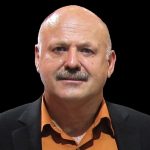


There’s something striking about American Pachuco: The Legend of Luis Valdez. For much of the documentary, one question keeps surfacing: How is it possible that Luis Valdez remains relatively unknown outside certain cultural circles and the Chicano community?
His name is tied to some of the most significant chapters in the Mexican American experience: the California farmworker strikes, the rise of contemporary Chicano theater, Zoot Suit, and La Bamba. Yet he rarely occupies the same place in the public conversation as other playwrights and filmmakers whose work helped shape American culture in the 20th century.
Director David Alvarado’s documentary begins with that very contradiction. Rather than introducing audiences to a forgotten figure, it explores how someone with such a profound impact on American arts and culture ended up occupying a surprisingly modest place in the nation’s collective memory.
Born in 1940 to a family of migrant farmworkers, Valdez grew up moving through California’s Central Valley. It was a world that, for decades, was largely absent from film, television, and theater. When he joined the movement led by César Chávez in the 1960s, he discovered that theater could be as powerful a tool for organizing people as any political speech.
That vision led to the creation of El Teatro Campesino in 1965, during the Delano grape strike. Performances took place on picket lines, at union meetings, and in the fields themselves. The goal was not to gain access to prestigious cultural institutions. It was to speak directly to people who rarely saw their lives reflected on stage.
One of the film’s strengths is that it refuses to treat those years as merely a prelude to later success. In Valdez’s story, art and activism are inseparable. It is difficult to fully understand one without the other.
A significant portion of the documentary focuses on Zoot Suit, the groundbreaking play that reached Broadway in 1979, becoming the first Chicano production ever staged there. Today, Latino stories have a more visible presence in American cultural life. At the time, that was far from the case. For many Mexican Americans, Zoot Suit offered a rare opportunity to see themselves at the center of an American story rather than at its margins.
The pachuco stands at the heart of that story. For Valdez, the character was never simply a symbol of a particular style or era. In the documentary, the pachuco becomes a representation of someone who belongs to the United States but is constantly asked to prove it. Someone caught between worlds, fully accepted by neither.
Viewed from 2026, that idea carries an unmistakable relevance. Debates over immigration, citizenship, and identity remain central to American political life. The documentary does not go out of its way to draw direct comparisons to the present, but it hardly needs to. Many of the questions that shaped Valdez’s work continue to resonate today, even if the language surrounding them has changed.
Another strength of American Pachuco is the range of voices that help tell Valdez’s story. The film features interviews with Edward James Olmos, Lou Diamond Phillips, Cheech Marin, Dolores Huerta, and Linda Ronstadt, among others. Their reflections do not portray Valdez as an untouchable icon. Instead, they paint a picture of someone who opened doors when few others were willing to do so and helped Latino stories find stages, audiences, and financial support.
That impact is especially clear when the documentary revisits La Bamba. When the film was released in 1987, Latino-led stories remained a rarity in Hollywood. Ritchie Valens’ life reached mainstream audiences without turning his Mexican heritage into an exotic curiosity or a constant explanation. For many Mexican Americans, it was a rare experience: seeing themselves reflected in a major studio film without the burden of stereotypes or caricatures.
The documentary is also enriched by an extensive collection of archival footage, much of which remained undigitized for decades. The material captures rehearsals, meetings, performances, and everyday moments. It serves as a reminder of something that is easy to overlook once social and cultural movements are distilled into history books: the people living through them rarely realize they are witnessing history in real time.
What unfolds on screen is not a series of grand historical moments, but people working, improvising, debating, and finding ways to keep their projects alive with limited resources.
By the end, American Pachuco makes clear just how much of modern Chicano cultural history is connected to Valdez’s work. The film wisely avoids presenting him as a lone hero, and it does not credit him single-handedly for broader social and cultural changes. Instead, it places him where he arguably belongs: within a larger network of artists, activists, and workers who helped expand who gets to tell stories in the United States and whose stories get heard.
When the credits roll, one thought lingers. Luis Valdez was there all along. The surprising part is how many Americans are only now discovering him.
Fact Sheet
American Pachuco will screen at Digital Gym CINEMA.
Adress: 1100 Market St., San Diego, CA 92101
Director: David Alvarado
Running Time: 92 minutes
Release Year: 2026
Featuring: Cheech Marin, Dolores Huerta, Edward James Olmos, Lou Diamond Phillips, and Luis Valdez
Screenings
- Friday, July 31, 2026, at 4:30 p.m.
- Saturday, Aug. 1, 2026, at 7:00 p.m.
- Sunday, Aug. 2, 2026, at 3:30 p.m.
- Monday, Aug. 3, 2026, at 7:00 p.m.
- Tuesday, Aug. 4, 2026, at 2:30 p.m.
- Wednesday, Aug. 5, 2026, at 4:45 p.m.
- Thursday, Aug. 6, 2026, at 8:00 p.m.
Tickets: $13 general admission, $11 students, $9 seniors.
Trailer: https://www.youtube.com/watch?v=dzV-rScvPEQ


