

For decades, if you wanted to see San Diego from above, there was one place that stood above the rest — literally.
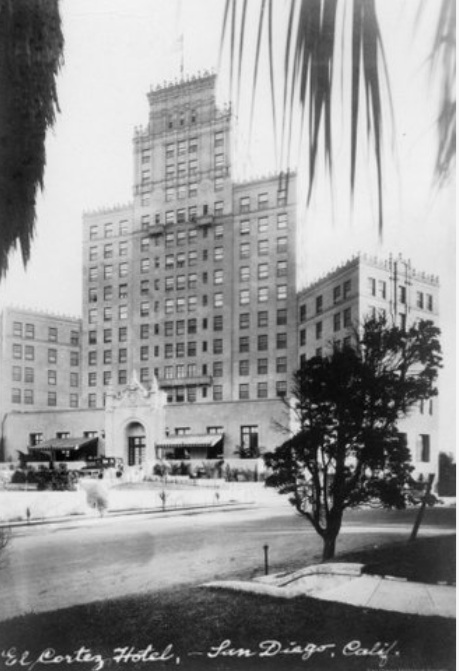
Perched atop Cortez Hill, the El Cortez Hotel was once the city’s tallest building. When it opened on Thanksgiving Day in 1927, its 310-foot tower dominated the skyline, offering sweeping views of downtown, San Diego Bay, Coronado, Point Loma and the Pacific Ocean.
Today, surrounded by downtown high-rises, it can be difficult to imagine how imposing the building once appeared.
The story of the El Cortez began with a very different residence.
The property had been home to Ulysses S. Grant, Jr., son of the 18th president of the United States. Grant’s Victorian-era home was demolished to make way for the El Cortez.
Construction began in 1926. Developer Richard T. Robinson Jr. hired Los Angeles architects Albert R. Walker and Percy A. Eisen to design the building. Their Spanish Colonial Revival design reflected the Spanish-influenced architecture that had become closely associated with San Diego following the 1915 Panama-California Exposition. The building was recognized by the National Register for its distinctive Spanish Colonial Revival design.
But the El Cortez wasn’t simply a hotel.

It was an apartment hotel, combining permanent residences with traditional hotel accommodations. When it opened, it contained 117 units: 85 apartments and 32 hotel rooms. The apartments featured living and dining rooms, kitchens with individual electric refrigeration systems, Murphy beds and other modern conveniences.
And then there were the views.
At 310 feet, the El Cortez stood above every other building in San Diego. Its upper floors provided sweeping views of the city, bay, and ocean, extending about 30 miles on a clear day.

The glamour continued in 1940, when the hotel added its famous Sky Room. Located on the 15th floor, the restaurant featured glass walls and 360-degree views of the city and surrounding area. It quickly became one of the hotel’s best-known attractions.
During World War II, however, the hotel’s lofty position took on a more serious purpose.
After the Japanese attack on Pearl Harbor on Dec. 7, 1941, the El Cortez became part of San Diego’s wartime defense. An anti-aircraft battery and radar station were installed on the roof, putting the landmark’s height to military use.
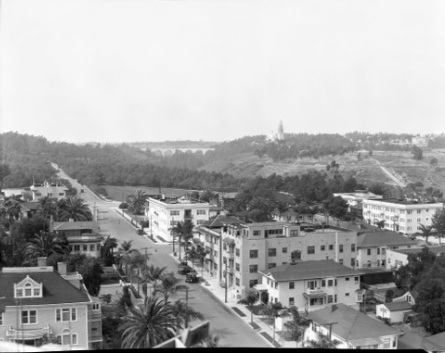
The hotel’s reputation for spectacle continued after the war.
Harry Handlery purchased the hotel in 1951 and oversaw a series of changes and additions. In 1956, the famous exterior glass elevator was installed along the tower. Known as the Starlight Express, it carried guests to the upper levels and became one of the El Cortez’s signature attractions.

But the El Cortez eventually struggled as downtown San Diego changed.
After decades as one of the city’s best-known hotels, it closed in October 1978. The building then went through years of uncertainty and declining fortunes, and by the 1980s it faced the possibility of demolition.
Preservationists fought to save it.

In July 1990, the city of San Diego designated the El Cortez a historic site, recognizing its importance as a landmark hotel, its association with prominent figures and events in San Diego history, and its architectural significance.
The El Cortez Apartment Hotel was added to the National Register of Historic Places on Jan. 17, 2002. The National Register recognized the building for its Spanish Colonial Revival design and its association with the architectural firm of Walker & Eisen.
The building was eventually converted to residential use, with 85 condominium units. Some of the additions from its later hotel years, including the exterior glass elevator and Sky Room, are gone.

The El Cortez today. (Photo courtesy of the National Register of Historic Places in San Diego County)
But the El Cortez remains on Cortez Hill, its distinctive tower still part of San Diego’s skyline.
Before the city grew upward around it, the El Cortez was the skyline.
Read more history stories here.
Sources:
San Diego History Center — “The Twentieth Century Life of the El Cortez Hotel.”
San Diego History Center — “U.S. Grant, Jr.: A Builder of San Diego.”
National Park Service — National Register of Historic Places Registration Form, El Cortez Apartment Hotel.
City of San Diego — El Cortez Historic Site No. 269.
Pacific Coast Architecture Database — El Cortez Hotel.


