


Some lost restaurant stories begin in archives. Others begin with an email.
When Jennifer Goulet first reached out, she was responding to an earlier piece about vanished San Diego restaurants and downtown history. She was trying to piece together fragments of her family’s downtown San Diego past — stories, photographs, business names, and memories passed down through generations but never fully assembled.
I was happy to help.
Help needed
In her first message, Goulet wrote, “I am a native, and my great-grandfather/grandmother had a business that I believe was on 4th and F. It was called Pete’s Jailhouse Café.”
That name became the starting point, but not the end.
As she dug through photographs and family notes, the story quickly became more complex. Even early research led to a dead end.
“I also researched Peter’s Jailhouse Café, and the search came up empty,” she later wrote.
I found the same result — there was no clear record of the café.
Missing pieces
That absence is common in early downtown histories. Names shift, buildings change hands and uses, and informal titles often survive in memory long after records disappear.
What emerged instead was an earlier reference to Pete’s Garden Café.
According to Goulet’s family history, the “Jailhouse Café” name appears to have come later, after the business was associated with or moved into a building that had once been a jail. What endured in memory was the latter name. The earlier identity — Pete’s Garden Café — surfaced through additional photographs and family records.
That shift reframed the story into a more layered picture of a downtown family business with multiple phases.
Ferrantelli Shoe Store
Her research also uncovered another branch of her family’s downtown presence: the Ferrantelli Shoe Store.
Among the materials she shared was a photograph dated July 14, 1937, showing the interior of the store at 909 Fourth Street in downtown San Diego. In the image, a man identified as “Mike” sits with a customer. Shelves of boxed shoes line the walls, and a life-sized stuffed kangaroo once stood outside the storefront, according to the original caption.
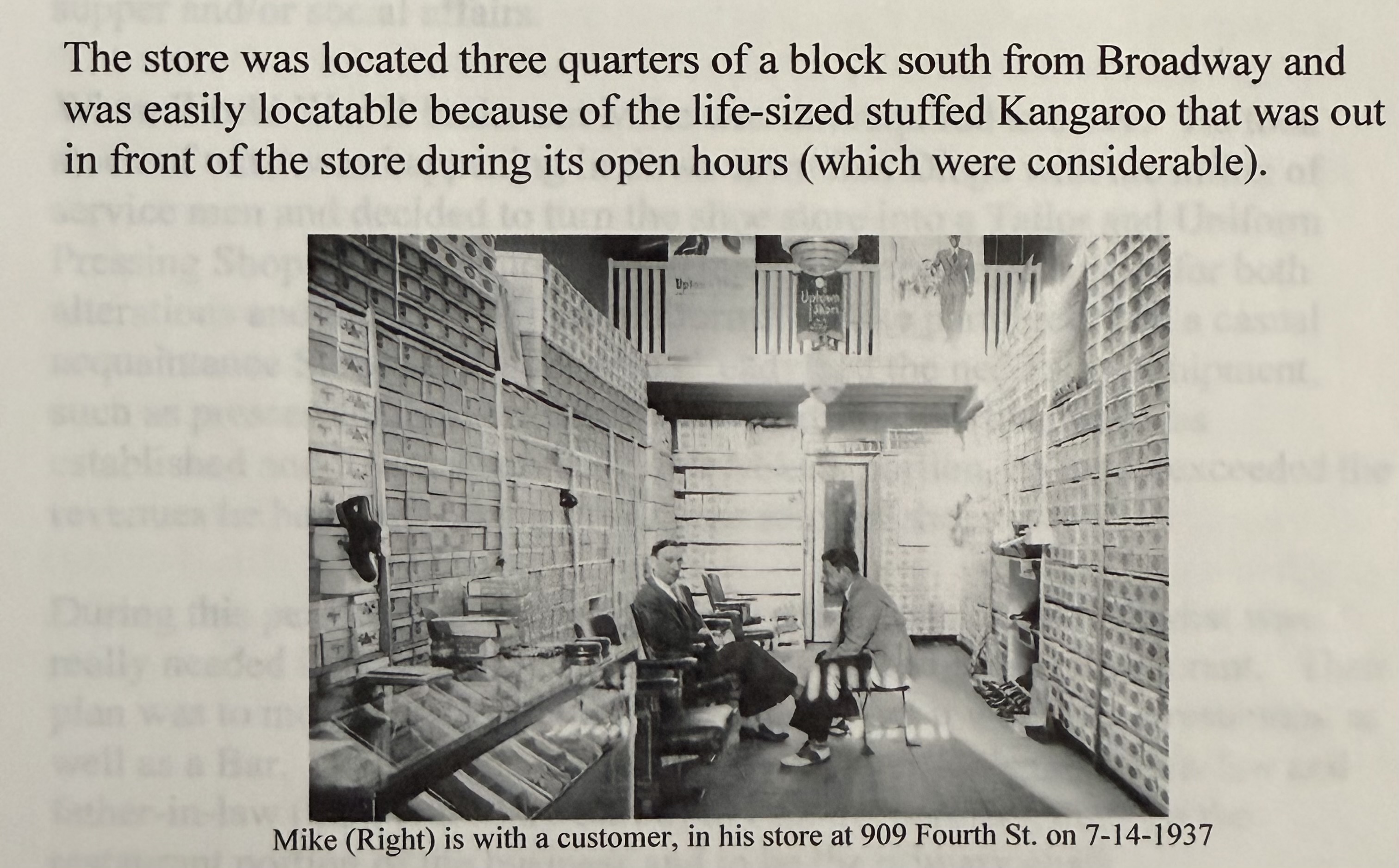
It is the kind of detail rarely preserved in formal records, yet these are, for historians, often the most evocative.
The photograph anchored the family’s presence in downtown San Diego, tied to a specific address and moment in the city’s pre-war commercial life.
She later clarified:
“The man seated in the shoe store, ‘Mike,’ is my grandfather, Michael Ferrantelli, the owner of the store (Pete’s son).”
That single detail turned a storefront image into a multi-generational family record.
She added: “He came from Sicily as a cobbler. Long San Diego history as others came to fish, he clothed their feet.”

An old newspaper article showing the inside of the Ferrantelli Shoe store. (Courtesy of Jennifer Goulet)
Alongside the shoe store history are memories of Pete’s Garden Café near Fourth and F streets in what is now the Gaslamp Quarter.
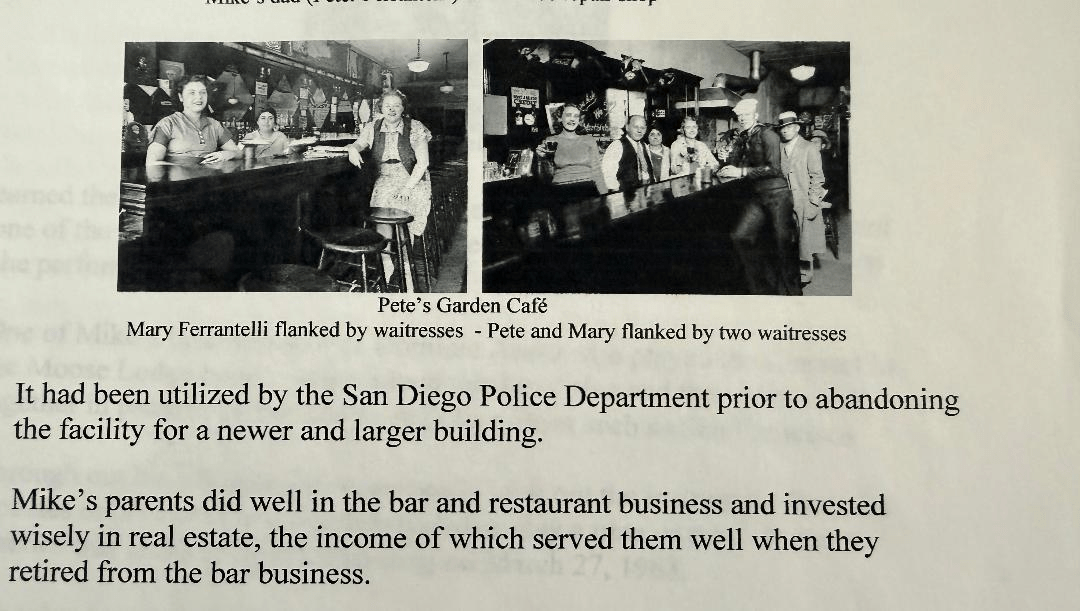
According to Goulet’s family, her great-grandparents prepared meals there while also washing and pressing military uniforms for servicemen passing through downtown during the wartime and postwar years.
One memory stood out:
“My Dad has told endless stories, as he remembers being three years old, riding around in his pedal car as the cigarette girls were trying to sell their wares.”
It captures an entire era — the mix of cafés, bars, small labor businesses, and military movement that defined downtown San Diego life.
Goulet also noted shifting family memories of where the restaurant was: “My mom thought the location was where the now-defunct Horton Plaza stands.”
More than a café
That uncertainty is common in older urban histories, where ongoing redevelopment can blur physical memory.
The story is not just one café, but the environment it existed in.
Before the Gaslamp Quarter became known for restaurants and nightlife, downtown San Diego was a dense working corridor. Fourth St. and the surrounding blocks held cafés, bars, shops, hotels, and service businesses serving workers, sailors, and travelers.
In that environment, buildings changed use frequently. A shoe store could become a café. A café could become a bar. Storefront identities often shifted within a generation.
Families adapted alongside those changes, moving between retail, food service, hospitality, and labor depending on opportunity.
The military presence intensified that rhythm. During World War II and after, nearby naval bases brought thousands of servicemen downtown daily. Cafés stayed open long hours. Meals were quick and inexpensive. Laundry, uniform pressing, and food service often operated side by side within the same blocks — and sometimes the same buildings.
Goulet’s material fits naturally into that pattern.
What makes the story compelling is how it resurfaced at all: Not through an archive, not through a preservation effort, but through a reader reconnecting fragments of family history through photographs and memory.
That process — revisiting old boxes, rediscovering captions, and reassembling names — is often how overlooked urban histories can return.
Not every business left formal records. Many operated briefly, while others changed identities. Some survive only because someone asks the right question about an old photograph.
Goulet captured that moment after uncovering materials beneath her home:
“Success today underneath the house. Permission to use all of it.”
Fast-forward
Today, the buildings along Fourth St. remain, but the world they once held is gone. The shoe store is gone. The many small cafés are gone. The wartime downtown that once served thousands of service members has been absorbed into redevelopment.
But through one family’s photographs and memories, a small piece of that older downtown comes back into view.
And Jennifer Goulet’s story becomes part of a larger truth about the city: that downtown San Diego once held a dense network of working cafés, shops, and small businesses shaped by movement, labor, and military life.
What began as a single inquiry opened into something more profound: how many everyday places disappear without notice, and how many survive only through memory.
Thank you for taking us back, Jennifer.
Read more history stories here, and do you have a story to tell? Send an email to DebbieSklar@cox.net.


